
Texas codes and permitting
Do You Need a Permit for a Home Generator in Parker County?
Texas rewrote the rules for residential backup power in 2025, and one of the two local twists lands squarely on Weatherford. Here is what applies where, written plainly.
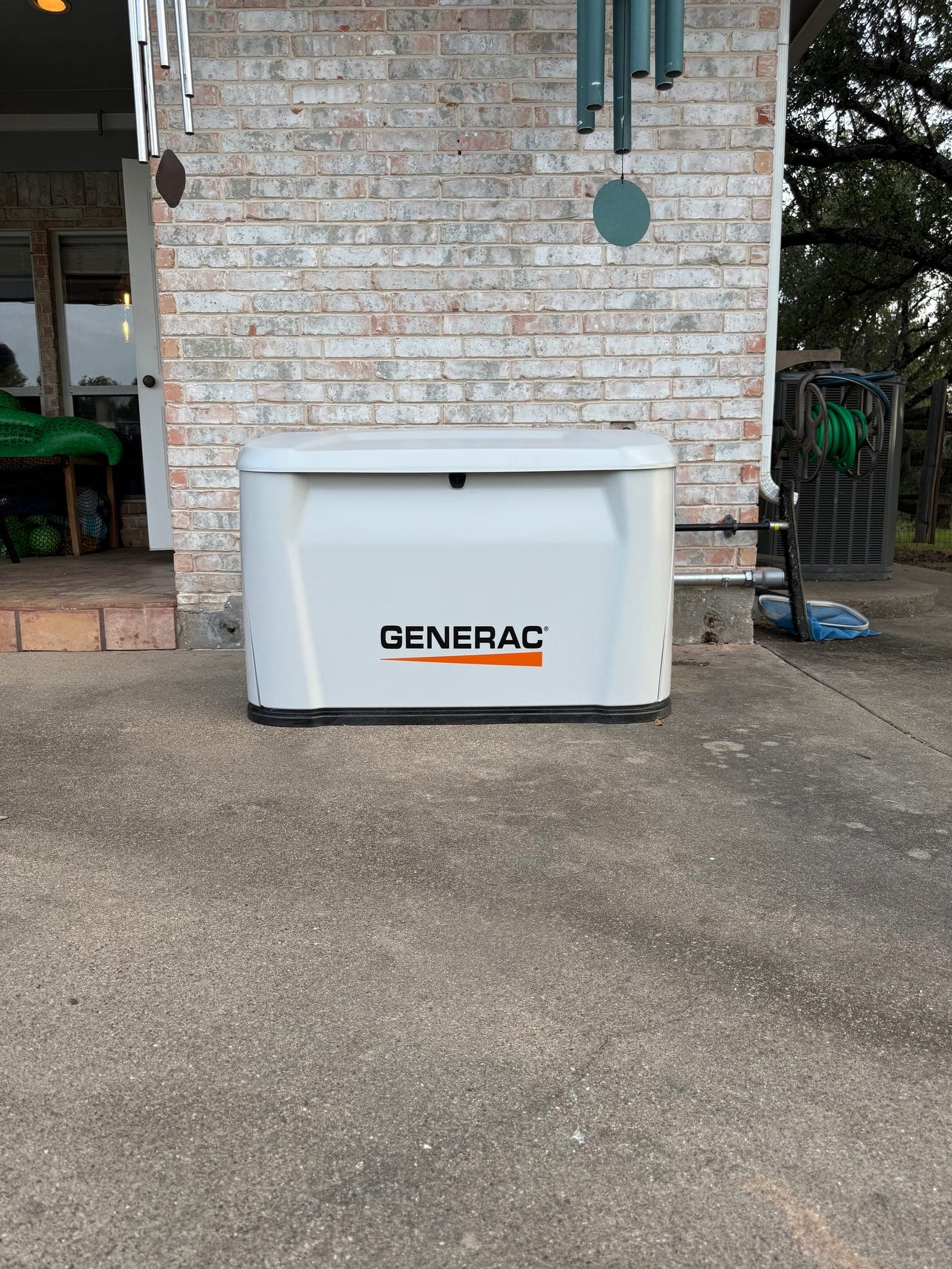
Since 1 September 2025, Texas municipalities may not regulate the installation or inspection of a residential backup power system at or below the statutory size threshold. There is one exception written into the law, and it applies here: a city that owns its own electric utility keeps that authority inside its service area. In this part of Texas, that means Weatherford.
This is an explainer, not a legal opinion. Codes get adopted, amended and interpreted differently by different offices, and the practical answer at your address is something we confirm during design rather than assume. What follows is the framework, the two local twists, and the parts that did not change at all.
What changed on 1 September 2025
Two bills from the 89th Legislature took effect that day. The first, Senate Bill 1252, preempts municipal regulation. Its operative language is short:
A municipality may not adopt or enforce an ordinance, rule, or other measure that would regulate the installation or inspection of a residential energy backup system.
A “residential energy backup system” is defined by capacity: one providing no more than 50 kilowatts to the residence, or with storage capacity not exceeding 100 kilowatt hours. Every home standby generator we install for a house sits under that ceiling, which means the statute is describing your project, not somebody else’s.
The second bill, Senate Bill 1202, works from the other direction. It covers a “home backup power installation” serving a one or two family dwelling at 600 volts or less, and it lets the installer elect a qualified third party for plan review, inspection, or both, instead of waiting on the local authority. Where a regulatory authority is involved, it has to act on the notice within three business days.
The Texas Department of Licensing and Regulation published its own notice on the change in August 2025, and it is worth reading if you want the regulator’s framing rather than a contractor’s.
The exception that matters here: municipally owned utilities
SB 1252 expressly preserves the authority of a municipally owned utility to regulate the installation and inspection of a residential energy backup system within that utility’s service area. It is one sentence, and around here it is the whole story.
The City of Weatherford owns and operates Weatherford Electric, a city-owned municipal utility. It is the only city in our service area that does. So a homeowner in a Parker County city with no municipal electric utility and a homeowner inside Weatherford Electric’s territory are now in different regulatory positions, for a reason that has nothing to do with the generator and everything to do with who owns the poles.
Weatherford Electric’s own Electric Service Policy is worth quoting on this, because it makes a point that applies to every generator owner regardless of where they live. Section 5.1.2, “Parallel Operation”:
Customer may not connect his lines to another source of electric energy in a manner that may permit electric energy to flow into City system from such source without written agreement with City.
That is the municipal-code version of the reason a proper automatic transfer switch exists. A transfer switch physically isolates your house from the utility before the generator picks up the load, so power cannot flow backwards onto a line a crew may be working on. An extension cord backfeeding a dryer outlet does the opposite, and it is the practice that puts line crews in hospital.
The same policy, at section 3.8, requires that inspections be requested by the customer and coordinated through the City Inspections Department inside the city limits or the Electric Department outside them, and that the installation pass inspection before energization. Note the second half of that sentence: Weatherford Electric serves customers outside the city limits as well, so the city-limit line and the utility service boundary are not the same line.
What we are deliberately not doing here is telling you exactly which form Weatherford will want for your specific job. That is a current-practice question for the city, and we confirm it with them per project rather than publishing an answer that ages badly.
Unincorporated Parker County
A great many of the properties we work on are not inside any city at all. Parker County states on its own permitting page that it does not issue building permits or certificates of occupancy, and there is no zoning in the unincorporated areas. For a residential generator on acreage, that removes a step a lot of homeowners expect to be there.
It does not remove the rest. What still governs the job on unincorporated land is the same list that governs it everywhere, and it is not a short one. More on that below.
| Where the property sits | Effect of the 2025 statutes | What still applies |
|---|---|---|
| Unincorporated Parker County | Little practical change; the county states it does not issue building permits or certificates of occupancy | Licensing, NEC, gas code, manufacturer clearances, electric utility rules, deed restrictions |
| A city with no municipally owned electric utility | Municipal regulation of installation and inspection is preempted for systems at or below the threshold | Same list, plus anything the city regulates that is not installation or inspection of the backup system |
| Inside Weatherford Electric’s service area | The municipally owned utility exception applies, so the utility may still regulate installation and inspection | Same list, plus the utility’s service policy, including parallel-operation and pre-energization inspection provisions |
| Anywhere in Texas | SB 1202 allows the installer to elect qualified third-party plan review or inspection | Non-exempt electrical work must be performed by a licensed Texas electrical contractor |
General orientation only, current as of August 2026, and not legal advice. Statutes, adopted code editions, utility policies and local practice all change, and boundaries between cities, counties and utility service areas do not line up neatly. We confirm the requirements for your specific address with the authority having jurisdiction as part of the design.
What did not change
This is the half of the story that gets lost when a headline says Texas “eliminated generator permits.” The 2025 statutes are narrow. They address how a municipality may regulate the installation and inspection of a residential backup power system. Everything on this list is untouched.
- Electrical licensing. TDLR states that non-exempt electrical work in Texas, including work relating to residential energy backup systems, must be performed by licensed Texas electrical contractors with licensed electricians, in accordance with Chapter 1305 of the Occupations Code and the National Electrical Code. Armored Power Systems holds TECL #41587 and works under Master Electrician oversight.
- The National Electrical Code. Generators and their transfer equipment fall under NEC Article 702, Optional Standby Systems. Adopted editions vary by jurisdiction, so the governing edition is a per-address question.
- Fuel and gas code. Gas piping, sizing, pressure, regulators and propane tank siting are their own body of rules, and none of it moved.
- Manufacturer installation instructions. Clearances from openings, combustible walls, propane tanks and gas meters come out of the unit’s manual and the applicable fire code, not out of a city ordinance. Getting these wrong can void the warranty and create a genuine carbon monoxide risk.
- Your electric utility’s service rules. Whoever delivers your power still has requirements about what may connect to their system and when it may be energized.
- Deed restrictions, HOAs and platted subdivisions. A private covenant is not a municipal ordinance, and state preemption of city rules does not touch it.
- Septic and site constraints. On acreage the drainfield, the well and the setbacks often decide the pad location before code does.
Read that list again and the practical effect of the 2025 change comes into focus. It removed a layer of municipal process. It did not turn a generator into a weekend project.
What SB 1202 actually gives an installer
The third-party option is the part with the most day-to-day effect. Where a plan review or inspection is in play, the installer can elect a qualified third party rather than queue for the local office. The statute defines who qualifies: Texas master electricians, electrical inspectors certified by the recognized inspection bodies, and Texas-licensed professional engineers. Where a regulatory authority is notified, it has three business days to act, and it may not charge a fee it has not published in a fee schedule.
For a homeowner, the honest translation is that the review step is less likely to be the thing that delays your installation date. It is not a way around inspection, and it is not a reason to skip one.
How we handle it on a job
Permitting and utility coordination are part of the design phase, before equipment is ordered. On a typical standby generator installation that means four things.
- Establish the jurisdiction properly. City limits, extraterritorial jurisdiction, county, and separately the electric utility service area, because those boundaries do not coincide. This matters more in Parker County than almost anywhere, since three different electric regimes operate inside one county.
- Confirm current requirements with the authority having jurisdiction. Asked fresh, per project. Practice changes, and a statute taking effect does not instantly rewrite every counter procedure in the state.
- Design to the code and the manual, not to the minimum. Clearances, transfer switch type, conductor sizing, gas sizing and grounding get done properly regardless of who is inspecting, because the inspection is not the point of the work.
- Coordinate energization. Where the utility requires an inspection pass before the service is energized, that sequencing goes in the schedule at the start instead of being discovered at the end.
Sources
Everything above is checkable, and we would rather you checked it than took our word for it.
- Texas SB 1252, 89th Legislature, enrolled text
- Texas SB 1202, 89th Legislature, enrolled text
- TDLR notice on SB 1252 and residential energy backup systems
- Parker County permitting information
- City of Weatherford Electric Service Policy (PDF), including §3.8 and §5.1.2
- Weatherford Electric, City of Weatherford
If you want the answer for one specific address rather than the general framework, request an estimate. Working out which rules apply to your property is the first thing we do, and it happens before anyone talks about equipment.
Written by the Armored Power Systems team. Systems designed under Master Electrician oversight, TECL #41587.
Common questions
Permitting questions we get asked most
Did Texas make home generator permits go away?
Not entirely, and the difference matters. SB 1252 stops a municipality from adopting or enforcing an ordinance, rule or other measure that would regulate the installation or inspection of a residential energy backup system at or below the statutory threshold. It expressly preserves the authority of a municipally owned utility to regulate installation and inspection inside its own service area, and it changed nothing about electrical licensing, the National Electrical Code, gas code or the manufacturer instructions.
Why is Weatherford treated differently?
Because the City of Weatherford owns and operates its electric utility. SB 1252 carves municipally owned utilities out of the preemption, so a city that runs its own power system may still regulate installation and inspection within that service area. Weatherford is the only city in our service area with a municipal electric utility, which is why a homeowner there and a homeowner a few miles away can be in genuinely different positions.
Do I need a permit on unincorporated Parker County land?
Parker County states on its own permitting page that it does not issue building permits or certificates of occupancy, and there is no zoning in the unincorporated areas. That is not the same as saying nothing applies. Electrical licensing, the National Electrical Code, gas code, the manufacturer clearances, your electric utility rules and any deed restrictions on your property all still govern the work.
Can I install a generator myself in Texas?
Not the electrical portion. TDLR is explicit that non-exempt electrical work in Texas, including work relating to residential energy backup systems, has to be performed by licensed Texas electrical contractors using licensed electricians. The 2025 statutes changed how municipalities may regulate installation and inspection. They did not change who is allowed to do the work.
Who handles the permitting and the utility coordination on your jobs?
We do, as part of the design. We confirm what the authority having jurisdiction requires at your specific address before the equipment is ordered, because the answer changes across a county line, a city limit and a utility service boundary. Codes and interpretations also change over time, so we verify rather than rely on what was true on the last job.
Related
Keep reading
- Standby Generator InstallationA permanently installed system that starts on its own when the utility drops and runs the house until power returns.
- Our ProcessSite visit, load calculation, written proposal, permitting, install, startup.
- Parker CountyGenerator installation and service across Weatherford, Aledo, Springtown, Brock and the county.
- Automatic Transfer SwitchesThe device that senses the outage, isolates the utility and decides which circuits come back on.
Two ways to start
Which one are you?
Need a generator
We start with what has to keep running at your property — the well, the AC, the freezer, the shop — and size the system around it. You get a written proposal with the equipment, the electrical work and the site prep all in one number.
Already own one
Repair, diagnostics and scheduled maintenance for Generac, Kohler and Briggs & Stratton systems — including units another company installed. Tell us the brand and what it is doing and we will bring the right parts.