
Buying guide
Do I Need a Generator for My Well Pump?
If your water comes from a well, a power outage is a water outage. The pressure tank buys you minutes, not days, and the pump is the hardest load on the property to start.
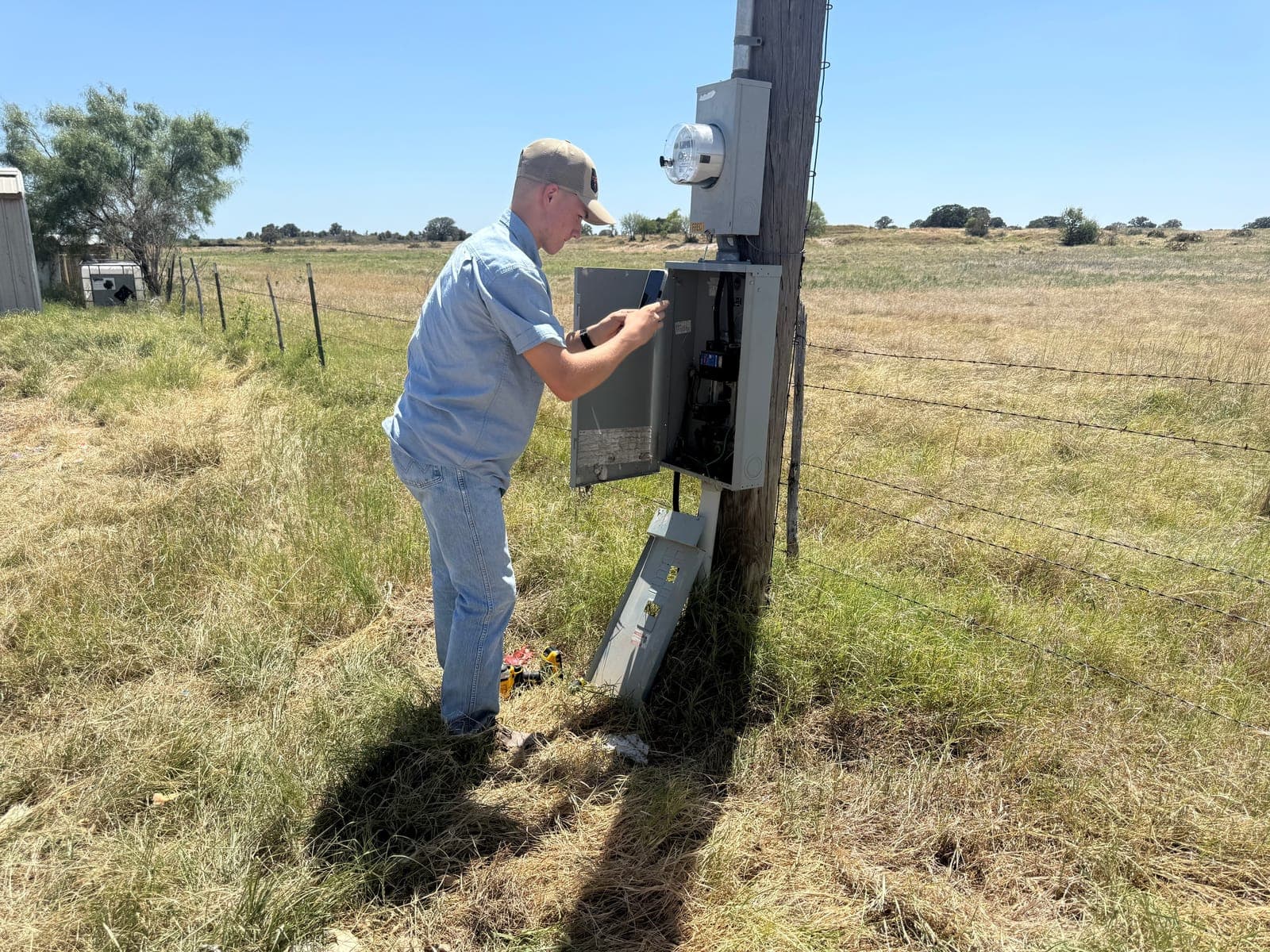
On a private well, losing power means losing water. Not gradually, and not after a day. The pressure tank holds a few minutes of normal use, and once it is down to cut-in pressure there is nothing behind it. No showers, no laundry, no dishes, no flushing, and no water for livestock.
The Texas Comptroller’s review of the February 2021 storm found that about 49 percent of Texans experienced disruptions in water service, averaging 52 hours. For households on municipal systems that came from failures upstream. For households on wells, it came from the same outage that took the lights.
How much water you actually have
People overestimate this badly, and the reason is that a pressure tank is mostly air. A bladder tank stores water under pressure between the pump’s cut-in and cut-out settings, and the usable volume, the drawdown, is only a portion of the tank’s nominal size. At a common 40 to 60 psi setting, expect somewhere between roughly a quarter and a third of the nominal volume to be usable.
Put numbers on that. A tank sold as 44 gallons might give you twelve to fourteen gallons of water. A shower uses two to two and a half gallons a minute. A toilet flush is around a gallon and a half. So the entire reserve at your house is roughly five minutes of shower, or eight or nine flushes, and then the tap runs to a trickle and stops.
Livestock make it sharper still. A single beef cow can drink well over ten gallons a day in summer heat, and troughs on float valves refill from the same well. A three-day outage in August is not a comfort problem on a working property.
What a submersible pump demands electrically
Residential submersible pumps in this part of Texas are typically 240 volt, single phase, and somewhere between a half and one and a half horsepower. Two characteristics make them the hardest load on most properties.
First, they start under load. There is no unloading valve and no gentle spin-up. The motor sits at the bottom of the well against full head pressure and has to break loose against it, drawing several times its running current for the instant it takes to reach speed.
Second, they are invisible. Nobody hears the well pump from the kitchen, so it is routinely missed on load lists compiled from what the household notices. It is the single most common omission we find in other companies’ sizing work, and it is the load most likely to make an undersized system fail.
Whether the pump is two-wire or three-wire changes the picture slightly. Three-wire pumps use a control box at the surface containing the start capacitor and relay, which softens the start a little and gives a technician something to test. Two-wire pumps have the start components downhole. Either way the surge is what the generator has to survive.
| Pump | Running watts | Starting watts | Notes |
|---|---|---|---|
| 1/2 HP submersible | ~1,000 | 2,000 – 2,500 | Shallower wells, lower demand |
| 3/4 HP submersible | ~1,500 | 3,000 – 4,000 | Common mid-range |
| 1 HP submersible | ~2,000 | 4,000 – 6,000 | Very common on acreage here |
| 1.5 HP submersible | ~2,800 | 6,000 – 8,500 | Deeper wells, higher flow demand |
| 1/2 HP shallow-well jet pump | ~800 | ~2,000 | Surface mounted, easier to start |
| Constant-pressure controller, 1 HP | ~2,000 | Ramped, far lower surge | Variable-speed drive softens the start |
Typical planning figures only, not a quote and not a substitute for your pump's nameplate or control box data. Figures assume single-phase 240 V submersible pumps with a conventional across-the-line start. Actual draw varies with head pressure, wire run length, motor age and manufacturer. Constant-pressure variable-speed controllers change the starting behavior substantially.
Why a portable generator often cannot do this
Compare the running watts against a portable generator’s rating and the well looks easy. Four things get in the way.
- Surge capacity. A portable rated for a few thousand running watts and a modest surge may simply refuse to bring a one horsepower submersible up to speed. It will try, the voltage will sag, and either the breaker trips or the motor sits there drawing locked-rotor current, which is how pumps get damaged.
- Voltage drop. The well head is often a long way from where a portable will sit. Undersized or overlong cord runs cost you voltage exactly when the motor needs it most.
- The connection. A well pump is a hard-wired 240 volt circuit, not a plug. The only legal and safe way to feed it from a generator is through a transfer switch or a listed interlock. Backfeeding through a dryer outlet with a double-ended cord energizes the utility service and can kill a line worker restoring your power. There is more on the code and utility framework in our guide to generator permitting in Parker County.
- It needs a person. A portable has to be rolled out, fueled, started, refueled every few hours and shut down. That means someone at home and awake. It also means an engine running outdoors, and carbon monoxide poisoning was among the causes of death tallied by the state after the February 2021 storm, when people ran engines and grills for warmth. A permanently installed unit sits outside, vents properly and starts by itself.
None of that makes portables useless. It makes them a poor match for the specific job of running a well, which is the load that most needs to keep working and the one least suited to a manual solution.
The septic side, which is where it gets expensive
Septic is normal here rather than unusual. TCEQ’s on-site sewage facility permitting data shows Erath County issuing 264 new septic authorizations in 2025 and Palo Pinto County 133, against 273 for all of Tarrant County, which has vastly more housing. On acreage in this part of Texas, an on-site system is the default.
A conventional gravity system needs no power at all. An aerobic treatment unit is a different machine. It runs an air compressor continuously to keep the aerobic bacteria alive, and most installations include a pump tank with an effluent pump and float switches, often feeding a spray field. Houses that sit below their tank or drainfield also have a lift pump.
Here is the part that catches people out, and it is the reason this section exists. On a well with no generator, nothing flows into the septic system, because there is no water. Put a generator on the house, restore the well, and now the household is using water normally while the effluent pump and the aerator are still dead. Water goes in and cannot go out. The pump tank fills, the high-water alarm sounds, and on a multi-day outage you are looking at a backup.
The fix is trivially cheap at design time and awkward afterwards: put the aerator and the effluent pump on the backed-up circuits alongside the well. They are small loads. They are just easy to forget, because nobody thinks about a septic system until it stops behaving.
One more note for aerobic system owners: the bacterial colony degrades when the aerator stops for an extended period, and it takes time to recover afterwards. Keeping the compressor running during an outage is not only about the pump tank.
Constant-pressure controllers change the arithmetic
If your well already has a constant-pressure or variable-speed controller, say so early, because it materially affects the generator size. These controllers ramp the motor up rather than throwing it across the line, which cuts the starting surge dramatically and can move a property down a size class.
If your well does not have one, it is worth a conversation with your well contractor. On the right property, adding constant-pressure control and buying a smaller generator can cost less overall than buying a bigger generator to survive an across-the-line start, and you get better water pressure the other 364 days of the year.
How we design around a well
On a well property, the well is the first thing we look at and the last thing we compromise on.
- Read the actual equipment. Pump horsepower, voltage, two-wire or three-wire, controller type, and the condition of the wiring at the well head.
- Design the transfer scheme around the must-run loads. Well, septic aerator and pump, refrigeration, heat or cooling, then everything else. The choice between essential circuits and whole-home coverage is set out in what a whole-home generator powers.
- Use load management so the pump always wins. Load management can hold off the water heater and the shop so the well pump has the headroom it needs at the moment it starts, which frequently means a smaller generator does the job.
- Test it under load at commissioning. Not a no-load run. The well starting, with the house connected, watching what the voltage does.
That is the whole argument for a permanently installed system on a well property. It starts without you, it starts the pump properly, and it keeps running while you are at work or asleep or two counties away. If that is the position you are in, the standby generator installation page covers what the project involves, and we cover well properties across Parker, Palo Pinto and Erath counties.
Written by the Armored Power Systems team. Systems designed under Master Electrician oversight, TECL #41587.
Common questions
Well and septic questions
Will a portable generator run my well pump?
Sometimes, and less often than the wattage numbers suggest. The running load of a one horsepower submersible fits comfortably inside a mid-size portable. The starting surge frequently does not, and voltage drop over a long cord makes it worse. There is also the connection problem: a well is a hard-wired 240 volt circuit, so a legal connection needs a transfer switch or interlock, not an extension cord.
What size generator do I need just for a well pump?
The pump is not the question; the surge is. As a planning figure, a one horsepower 240 volt submersible draws roughly 2,000 watts running and can demand four to six thousand watts for the instant it starts. A generator has to absorb that surge while still carrying whatever else is on at the time, which is why the well is almost always the load that sets the size of the whole system rather than a load you size on its own.
How long will my pressure tank last once the power goes off?
Less than most people expect. A residential bladder tank delivers only a fraction of its nominal volume as usable drawdown between the cut-in and cut-out pressures, commonly somewhere between a quarter and a third at a typical setting. In practical terms that is a few minutes of shower or a handful of toilet flushes, not a day of normal household use.
Does my septic system need electricity?
A conventional gravity septic system does not. An aerobic treatment unit does, and those are common on acreage in this area. Aerobic systems run an air compressor continuously to keep the treatment bacteria alive, and most have a pump tank with an effluent pump and float switches. Houses sitting below their tank or drainfield also have a lift pump. All of those stop when the power does.
Can I back up only the well and leave the rest of the house alone?
You can, and on a tight budget it is a defensible choice. An essential-circuit design covering the well, the septic pump, refrigeration and some lighting is far cheaper than whole-home coverage. Be aware that the generator still has to be large enough to start the pump, so the saving comes from the transfer switch and the scope of work rather than from a much smaller machine.
Related
Keep reading
- What Size Generator Do I Need for My House?Square footage is a proxy, not a method. Here is what actually sets the size: motor starting loads, how many of them can run at once, and whether the system manages them.
- Generator SizingA load calculation that decides how much generator your property actually needs — before anyone quotes a price.
- Load ManagementSmart load control that lets a smaller, cheaper generator cover a bigger house.
- What Does a Whole-Home Generator Power?The badge on the enclosure does not decide what stays on. The transfer switch and the load plan do. Here is what that looks like system by system.
Two ways to start
Which one are you?
Need a generator
We start with what has to keep running at your property — the well, the AC, the freezer, the shop — and size the system around it. You get a written proposal with the equipment, the electrical work and the site prep all in one number.
Already own one
Repair, diagnostics and scheduled maintenance for Generac, Kohler and Briggs & Stratton systems — including units another company installed. Tell us the brand and what it is doing and we will bring the right parts.