
Generator services
Automatic Transfer Switches
The generator makes the power. The transfer switch decides whether any of it reaches your house, and which parts of the house it reaches. It is the most consequential component people never think about.
What it is
A switch with an opinion about the utility
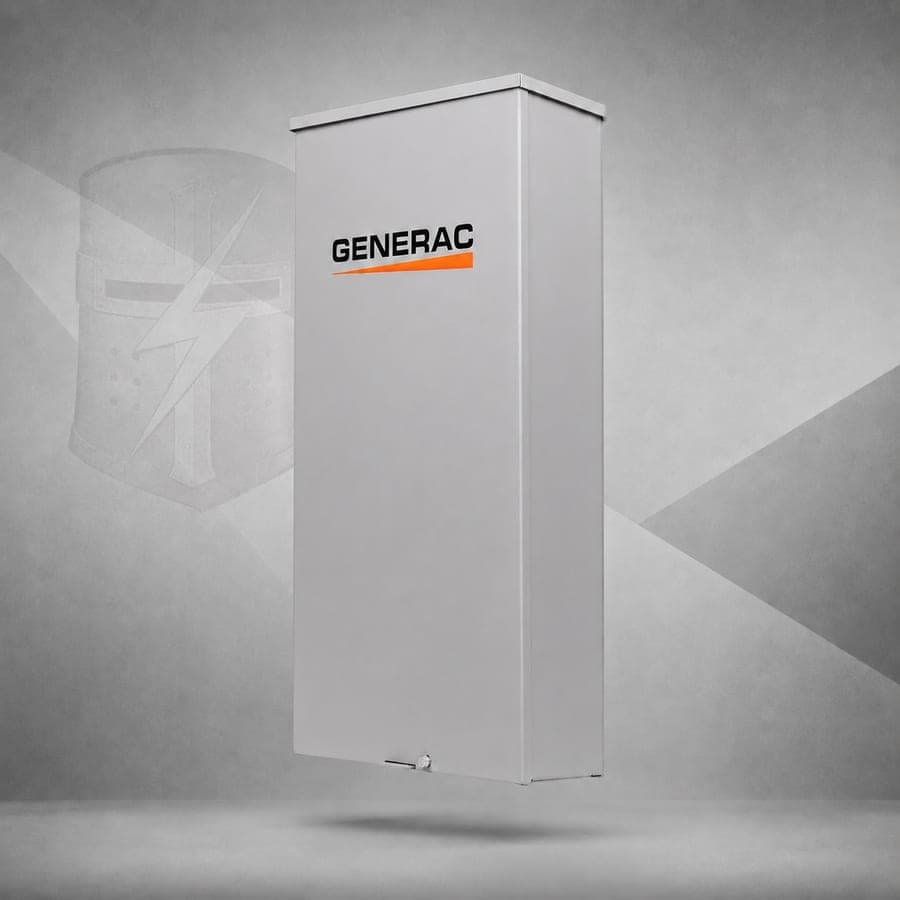
An automatic transfer switch, usually shortened to ATS, is a steel enclosure mounted near your electrical panel with two power sources landing in it: the utility, and the generator. Inside is a mechanism that can be connected to one or the other and never to both, plus a controller that watches the utility and makes the decision.
That never-both part is the entire safety case. If a generator were ever connected to the house while the house was still connected to the grid, it would push power back up the service drop and out onto the line that a utility crew believes is dead. The transfer switch makes that physically impossible rather than procedurally unlikely.
It is also the reason a standby installation is an electrical service job rather than an equipment delivery. The switch lands at or near your service entrance, which is licensed, permitted, inspected work.
The sequence
What happens in the twenty seconds after the lights go out
- 01
Sense
The switch monitors utility voltage on the incoming service continuously. When it drops out, or sags outside tolerance, a short confirmation delay runs so a momentary blink does not start the engine unnecessarily.
- 02
Start and warm up
The switch signals the generator to start and waits for the engine to reach stable voltage and frequency. Your house is still connected to a dead utility at this point, which is deliberate.
- 03
Transfer
The switch physically opens the utility connection before it closes onto generator power. The two sources are never bridged, which is what stops the generator backfeeding the line outside your house.
- 04
Retransfer and cool down
When utility power returns and holds for a set period, the switch moves you back and lets the engine run unloaded for a cool-down cycle before shutting off. Nobody has to be home for any of it.
Service rating
Service-rated or non-service-rated
The distinction sounds like paperwork. It changes what gets mounted on your wall and what the inspector expects to see.
Service-rated
Listed to sit at the service entrance and act as the main disconnecting means for the property. The utility feed lands in the switch, and the switch feeds the panel. It carries the overcurrent protection and the disconnect function that would otherwise live in a separate enclosure.
Fewer boxes on the wall, one clear point of disconnect for emergency responders, and a tidier installation on properties where the meter and panel are combined. It costs more, and it is often the right answer when the existing service has to be reworked anyway.
Non-service-rated
Installed downstream of an existing main disconnect. The utility still terminates where it always did, and the transfer switch sits between that disconnect and the load it is backing up.
Less expensive, and perfectly correct where the existing service is sound and the main disconnect is already where it needs to be. It means an additional enclosure, and it means the existing service equipment has to be in good enough condition to keep.
Which one your property needs comes out of the site assessment, not out of a catalog. Panel age, meter arrangement, available capacity and the local inspector all have a say. If your service is at its limit, an electrical panel upgrade may be part of the same conversation.
Coverage
Whole-home switches and essential-circuit panels
This is where the transfer switch stops being a technical detail and starts deciding what your outage actually feels like.
Whole-home
The switch carries your entire electrical panel. Every circuit in the house is live on generator power, and nobody has to remember which outlets work. Where total demand could exceed the generator, load-management modules briefly drop the heaviest non-critical loads instead of forcing you to give them up permanently.
This is the common choice now, largely because load management made it affordable. It also ages better. When you add a shop, a second AC unit or an EV charger, a whole-home design absorbs the change more easily than a fixed circuit list.
Essential circuits
A smaller switch feeds a dedicated sub-panel holding a defined set of circuits: refrigeration, well pump, furnace blower, some lighting, internet, medical equipment. Everything else waits for the utility.
Lower cost, lower fuel burn, and a smaller unit. The compromise is permanent and it is decided months before you experience it, which is why we go through the circuit list carefully during sizing rather than treating it as a formality.
Load shedding
The modules that make the maths work
A load-shedding module is a relay with a priority list. It sits on your heaviest circuits, usually the air conditioning, the electric water heater, the range and the dryer, and it watches how hard the generator is working. When demand approaches capacity, it drops the lowest-priority load for as long as it takes, then restores it.
The effect is that peak demand never actually lands on the engine. Your water heater goes quiet for ninety seconds while the compressor starts. You do not notice, and the generator does not have to be a size bigger to survive the moment.
Two things matter here and both get overlooked. The first is the priority order, which should reflect your household rather than a default. The second is revisiting it. A shedding order set for a three-person house does not necessarily suit the same house five years later with a shop and an EV charger on it. We check shedding behavior on every maintenance visit for exactly that reason.
When it fails
A perfect engine and a dark house
Transfer switch faults are frustrating because everything looks right. The generator starts on schedule every week. The controller shows no alarms. Then the utility actually drops and nothing happens, or the engine runs happily into a house with no power.
The reason is that on most systems the weekly exercise cycle does not transfer load. It proves the engine starts. It says nothing about whether the switch can sense a real outage, whether the contacts are still good, or whether the control wiring between the switch and the generator has survived five Texas summers.
We test the switch the way an outage does, by simulating utility loss and watching the full sequence through transfer and retransfer. If your unit is doing any of this now, start with generator repair and diagnostics and mention the symptom, because it usually tells us which part to bring.
Common questions
Transfer switch questions
Service ratings, manual versus automatic, and why a running generator can still leave you in the dark.
What does an automatic transfer switch actually do?
It watches utility power, decides when there is an outage, starts the generator, disconnects your house from the utility, and connects it to the generator instead. Then it does the whole thing in reverse when the power comes back. It is the component that turns a generator into a system you do not have to operate.
What is the difference between a service-rated and a non-service-rated transfer switch?
A service-rated transfer switch is built and listed to sit at the service entrance and act as the main disconnect for the property, so it replaces or absorbs that function rather than sitting behind it. A non-service-rated switch has to be installed downstream of an existing main disconnect. Service-rated switches usually mean fewer enclosures on the wall and a cleaner install, but they cost more, and which one your property needs depends on the existing service arrangement and what your inspector requires.
Can I use a manual transfer switch instead?
You can, and for a portable generator it is the safe and correct way to connect to the house. Someone has to be there to start the generator and throw the switch, which is the whole difference. A permanently installed standby system with an automatic switch works when you are asleep, at work, or three hours away.
Why does my generator run but the house still has no power?
That is the classic transfer switch symptom. The engine can run perfectly on its weekly exercise and never move your load across, because on most systems the exercise cycle does not transfer. Worn contacts, a failed transfer coil, a dead utility-sensing circuit or a damaged control wire will all produce a generator that runs into an empty room. It is one of the faults we look at most often in generator repair.
How does the transfer switch decide which circuits get power?
That is settled at design time, not during the outage. A whole-home switch carries the entire panel, with load-management modules dropping selected heavy loads briefly if demand spikes. An essential-circuits design feeds a dedicated sub-panel with a fixed list of circuits, and everything not on that list stays dark. Both are valid. The mistake is not knowing which one you bought.
Do load-shedding modules ever cause problems?
They can if the priority order was set badly, or if it was never revisited after the house changed. If your water heater is shedding constantly, or a circuit you rely on is being dropped, the fix is usually a priority reconfiguration rather than new hardware. We check shedding behavior as part of a normal maintenance visit.
Can a transfer switch be added to a generator that already has one failing?
Yes. Transfer switches can be replaced or upgraded without changing the generator, and it is a common job. It is also a reasonable moment to reconsider the design, because if the original switch was an essential-circuits panel and the house has grown since, replacing like for like may repeat a compromise you no longer need.
Related
Keep reading
- Standby Generator InstallationWhere the transfer switch fits in the whole project.
- Generator SizingDeciding what the switch will actually be asked to carry.
- Load ManagementShedding modules, priority order and soft starts.
- Generator RepairDiagnostics for a generator that runs but never transfers.
- Electrical Panel UpgradesWhen the service equipment has to be addressed first.
- Generator MaintenanceThe visit that tests the switch instead of trusting the exercise cycle.
Two ways to start
Which one are you?
Need a generator
We start with what has to keep running at your property — the well, the AC, the freezer, the shop — and size the system around it. You get a written proposal with the equipment, the electrical work and the site prep all in one number.
Already own one
Repair, diagnostics and scheduled maintenance for Generac, Kohler and Briggs & Stratton systems — including units another company installed. Tell us the brand and what it is doing and we will bring the right parts.