
Generator services
Generator Maintenance
A standby generator spends 99% of its life doing nothing and is then expected to be perfect on the one night it matters. Scheduled service is how that expectation stays realistic.
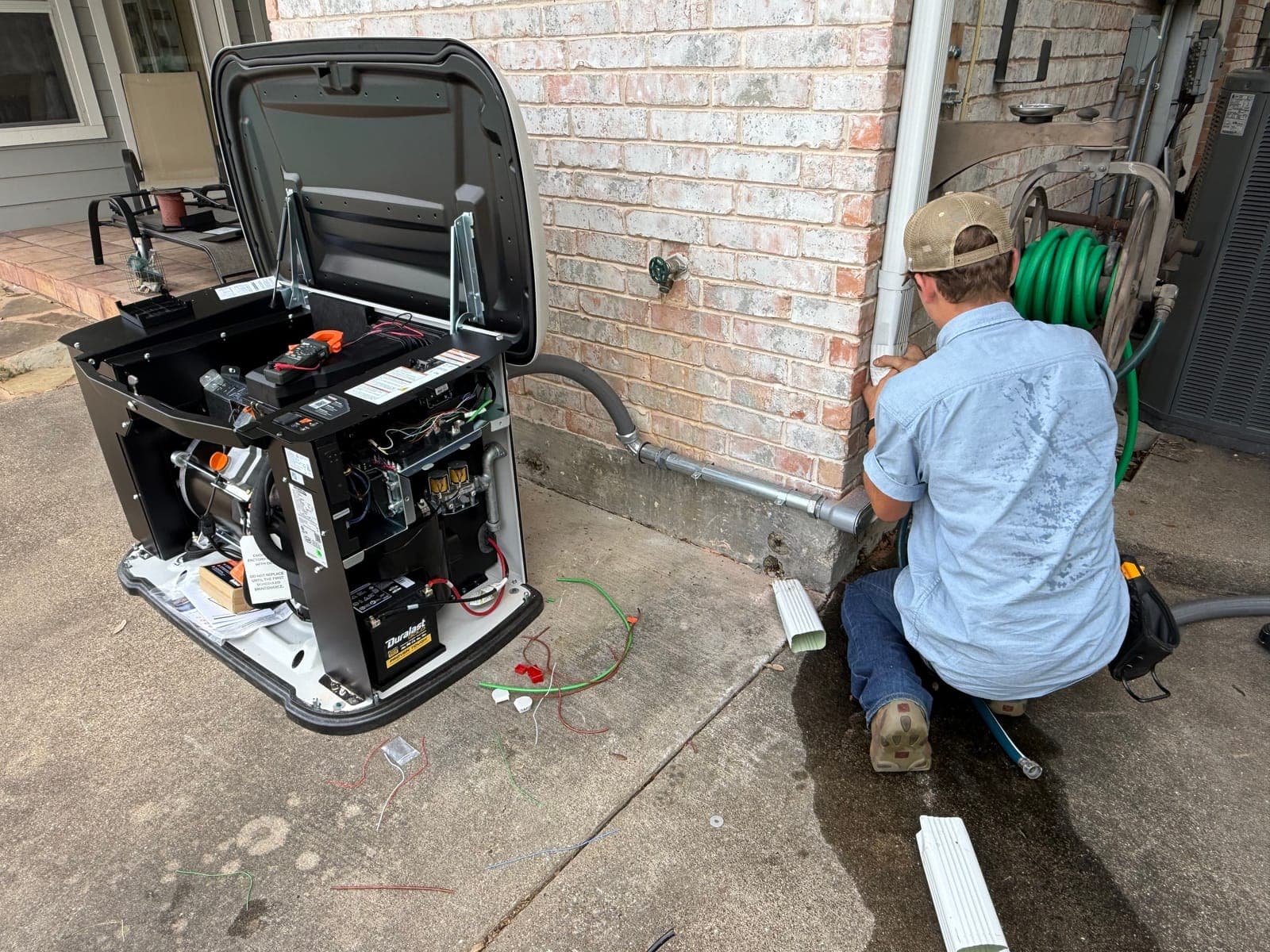
Why it matters
Four reasons standby generators fail, and all four are preventable
None of these are dramatic. That is exactly why they get skipped until the night they matter.
The warranty depends on it
Manufacturers expect documented, scheduled service to keep factory coverage intact. When a claim comes up, the service record is the first thing anybody asks for. Missing years are hard to argue with after the fact.
Batteries cause more no-starts than anything else
A standby generator lives on a single battery that spends its life on a trickle charger, doing nothing, in a metal box that bakes in July and freezes in January. That is a hard life. A battery can read fine at rest and still fail the moment the starter asks it for cranking current. Load-testing it once a year is the cheapest reliability you can buy.
Fuel systems drift
Regulators move out of calibration. Gas pressure sags when a neighborhood is all calling for heat at once. Propane tanks get low enough that vaporization struggles in the cold. None of this shows up until the engine is asked to run under load, which is exactly when you cannot afford to find out.
The exercise cycle is not maintenance
The weekly self-test proves the controller and the starter work. It does not check whether the oil has broken down, whether rodents have been at the wiring harness, whether the air intake is packed with dust and wasp nests, or whether the transfer switch will actually move your house across. Those are the failures that leave people in the dark.
There is a fifth reason that is less about the machine and more about the design. Systems change. People add a shop, a second AC unit, a pool pump or an EV charger, and the generator that was correctly sized five years ago is now covering more house than it was bought for. A service visit is a good moment to catch that before an outage does.
What a visit covers
A 45-point inspection, in plain language
We work through the same seven areas every time, in the same order, so nothing gets skipped because the machine looked fine from the driveway.
- 01
Controller and telemetry
Active alarms, the historical event log, firmware level, running hours, and how the control board is configured. The log usually tells us more about the last twelve months than the machine looks like it should.
- 02
Starting system
Cold-cranking performance under an actual load test, charger output voltage, starter engagement, and terminal corrosion. This is where most no-starts are prevented.
- 03
Engine and fluids
Oil condition and level, air filter restriction, spark plug wear and belt tension. Consumables get replaced when they are due rather than when they fail.
- 04
Fuel delivery
Static and running pressure across the natural gas or propane regulator, plus a check of the automatic fuel shutoff path. Pressure that looks fine at rest and collapses under load is a classic hidden fault.
- 05
Electrical output
A live run to verify output voltage near 240V and frequency near 60Hz, and to check that the engine holds steady when load is applied rather than hunting.
- 06
Transfer switch and grid isolation
Utility sensing, contact wear inside the automatic transfer switch, and whether the load-shedding modules actually shed in the right order. This is the part that decides whether the house comes back on.
- 07
Enclosure and site
Ventilation paths clear of debris and insect nests, exhaust clearances correct, and the concrete pad still level. Rural pads shift, and a unit sitting off-level is a problem long before it becomes obvious.
You get the findings afterwards, including on-site readings, component photographs and a clear estimate for anything that needs attention. Nothing is repaired without your approval first.
Plans
Put the visit on a schedule and stop thinking about it
The Armored Promise
Every new generator installation includes your first full year of routine maintenance, free.
We run three tiers, Shield, Armored and Fortress, in both annual and bi-annual versions. Every price and every inclusion is published on the maintenance plans page, so you can compare them without a phone call.
The short version: Shield covers the inspection and the diagnostics, with parts billed as they come up. Armored folds in the routine consumables, priority scheduling and reduced service-call rates, and suits most homes. Fortress adds active monitoring and covers labor and materials on the routine items, which makes sense on properties where an outage is genuinely expensive.
Plans can be moved up or down, or switched between annual and bi-annual, at any time. If your unit turns out to need repair rather than service, that is handled separately through generator repair and diagnostics.
Book a visit
Overdue for service?
If you cannot remember the last time anyone opened the enclosure, that is the answer. Tell us the brand and roughly how long it has been.
We will do a full diagnostic on the first visit if the unit is new to us, so you get an honest picture of its condition before deciding on a plan. That includes units another company installed and units that have been sitting untouched for years.
Common questions
Generator maintenance questions
Service intervals, what the exercise cycle does and does not prove, and what the plans actually cover.
How often should a standby generator be serviced?
At least once a year for a normal residential system. Twice a year makes sense if you sit on a feeder that drops often, or if the unit lives in heavy dust on rural acreage. Separately from the calendar, a generator engine typically needs a full oil and filter change after every 50 to 100 hours of continuous running, and a multi-day outage gets there faster than most people realize.
My generator runs its weekly exercise. Do I still need maintenance?
Yes. The exercise cycle confirms that the control board and the starter motor work. It cannot tell you the oil has broken down, that a rodent has chewed a sensor wire, that the starting battery has lost cranking capacity, or that fuel pressure sags when the engine is under real load. Those four failures account for most of the no-starts we get called out to.
What happens if you find a problem during the visit?
We document it, photograph it, explain it in plain terms and give you a flat-rate estimate before any repair work starts. Nothing gets fixed on assumption. If you are on one of the higher maintenance plan tiers, the plan discount applies to the parts and labor.
Do you service generators you did not install?
Yes, and it is a large part of what we do. A lot of homeowners were left without support when their original installer moved on. We run a full initial diagnostic on a unit that is new to us so we know its real condition, then put it on a normal service schedule from there.
Which brands do you maintain?
We service Generac, Kohler / Rehlko, Briggs & Stratton, Cummins, Champion, Honeywell. We install Generac and Kohler, and hold Generac dealer number 1033043 as an Authorized Sales and Service Dealer, so factory parts and documentation on those units come straight through us.
What is included in the first year after installation?
Every new generator installation includes your first full year of routine maintenance, free. After that first year you can move onto an annual or bi-annual plan, or call us visit by visit. The plans exist mainly so the service actually gets scheduled rather than remembered.
Do maintenance plans cover emergency repairs?
No. Routine maintenance plans cover scheduled service, not unexpected repair costs. What membership changes is your position in the queue and the rate: plan members get priority scheduling, and the higher tiers carry a 5% discount on repair parts, labor and future approved upgrades. Full plan details and prices are published on the maintenance plans page.
Related
Keep reading
- Maintenance PlansSix plans, annual and bi-annual, with prices and inclusions published.
- Generator RepairWhen the visit turns up something that needs fixing rather than servicing.
- Automatic Transfer SwitchesThe component the weekly exercise cycle never actually tests.
- Standby Generator InstallationNew installs include the first full year of routine maintenance.
- Our ProcessHow we document findings and quote work across every project.
- Generator SizingWorth revisiting if the house has grown since the unit went in.
Two ways to start
Which one are you?
Need a generator
We start with what has to keep running at your property — the well, the AC, the freezer, the shop — and size the system around it. You get a written proposal with the equipment, the electrical work and the site prep all in one number.
Already own one
Repair, diagnostics and scheduled maintenance for Generac, Kohler and Briggs & Stratton systems — including units another company installed. Tell us the brand and what it is doing and we will bring the right parts.