
Electrical services
Load Management and Load Shedding
The cheapest kilowatt in a backup system is the one you decided not to buy. Managing what runs simultaneously is how a smaller generator covers a bigger house.
The premise
Your house never runs everything at once
Add up the nameplate rating of every load in a typical Texas home and you get a number far larger than anything that has ever actually flowed through the meter. The two air conditioners do not both start at the same second. The oven and the dryer and the water heater and the well pump are not all pulling together on a Tuesday evening. The house has been managing itself by coincidence for years.
Utility power lets you get away with that, because the utility does not care. A generator does care, very much, because it has a hard ceiling and no ability to borrow. So the naive approach is to size the machine for the theoretical worst case and buy a great deal of capacity that will never be used.
Load management is the alternative. Instead of buying capacity for a scenario that will not happen, you make sure it cannot happen. Priorities get set in advance, the controls enforce them, and the load calculation that drives the whole project comes back with a smaller number.
Two different things
Load shedding versus load management
The terms get used interchangeably in sales conversations. They describe genuinely different behavior, and the difference is noticeable in your kitchen.
Trigger
- Load shedding
- The system is already near its limit and has to drop something now.
- Load management
- Decided in advance. Priority order is configured before an outage ever happens.
What you notice
- Load shedding
- A load disappears mid-cycle. Sometimes a dip, sometimes a compressor short-cycling.
- Load management
- A lower-priority load simply waits for its turn. Usually invisible.
Effect on sizing
- Load shedding
- Modest. It is a safety net, so the machine still gets sized close to worst case.
- Load management
- Substantial. Removing the simultaneous-start case is what shrinks the generator.
Equipment involved
- Load shedding
- Controller logic in the generator or inverter, sensing output and reacting.
- Load management
- Smart management modules on specific circuits, an essential-load panel, or both.
Best use
- Load shedding
- A backstop for the unusual day when something unexpected is running.
- Load management
- The everyday design tool. This is the one that changes the quote.
A well-designed system has both. Management handles the ordinary case so you never think about it, and shedding sits underneath as a backstop for the day somebody plugs in a welder. What you do not want is a system sold on shedding alone, where the experience of an outage is equipment being yanked offline mid-cycle.
Where the money is
How managed loads shrink the machine
Generators come in size steps, not on a sliding scale. Landing on the wrong side of a step is what makes a project expensive.
- 01
Measure the real numbers
Running amperage and startup amperage on each significant load, taken from the equipment on your property rather than from a table. Compressors in particular vary far more than people expect.
- 02
Find the simultaneous-start case
The peak that drives sizing is almost always two big things starting together: two AC units, or a compressor and a well pump. That single scenario is frequently the entire reason for the next size up.
- 03
Attack the inrush
A soft starter on the compressor ramps the motor instead of slamming it across the line. Manufacturers commonly cite inrush reductions of up to 70 percent, and it is usually the cheapest kilowatt on the project.
- 04
Set priority, then resize
Management modules or an essential-load panel prevent the overlap by design. Rerun the calculation against that and the required capacity drops, often by a whole size class.
The savings compound. A smaller unit costs less, but it may also mean a smaller transfer switch, a smaller gas supply and less fuel burned every hour of every outage for the next twenty years. We would rather sell you the right machine than the biggest one, which is why the load work happens before the quote rather than after it.
The equipment
Four ways to do it
Smart management modules
Individual controllers on the big 240-volt loads: air conditioning, water heating, pool equipment, the shop. Each one reports to the system and releases its load only when there is capacity for it.
Essential-load subpanel
A separate panel carrying only the circuits that must run. Simple, extremely reliable and easy to explain to anyone in the house. The trade-off is that adding a circuit later means physical work.
HVAC soft starters
Wired into the compressor to ramp the motor up rather than starting it across the line. Solves startup problems specifically, which is a different problem from running capacity and needs a different fix.
Integrated energy management
Platform-level control such as Generac PWRmanager, coordinating circuits alongside battery storage and solar. This is the option that also shapes how long stored energy lasts.
Which combination you end up with depends on the equipment already in the house and what else is planned. On a complete Generac energy system, PWRmanager coordinates circuits across solar, battery and generator, which is more capability than a generator-only property needs. On a straightforward standby generator installation, a couple of management modules and a soft starter frequently do the entire job.
Beyond generators
Load management matters even more with storage
A generator has a capacity ceiling but effectively unlimited endurance while fuel keeps arriving. A battery has both a ceiling and a fixed reserve, which means every managed load buys you two things: a lower instantaneous demand and a longer runtime. On a battery system, holding back the water heater is not just about avoiding a trip, it is about whether the lights are still on in the morning.
The same logic explains why smart thermostat integration keeps coming up. Letting the house drift a couple of degrees during an outage is one of the largest levers available, because HVAC is almost always the biggest consumer on the list. That is a control decision, not an equipment purchase.
And on a property with an EV charger, management stops being optional. A charger drawing 40 amps for hours is comparable to a second air conditioner running continuously, and it is the one large load that can genuinely be deferred to two in the morning without anybody minding.
Equipment
What actually does the managing
Load management is a device decision as much as a design one. These are the three we reach for.
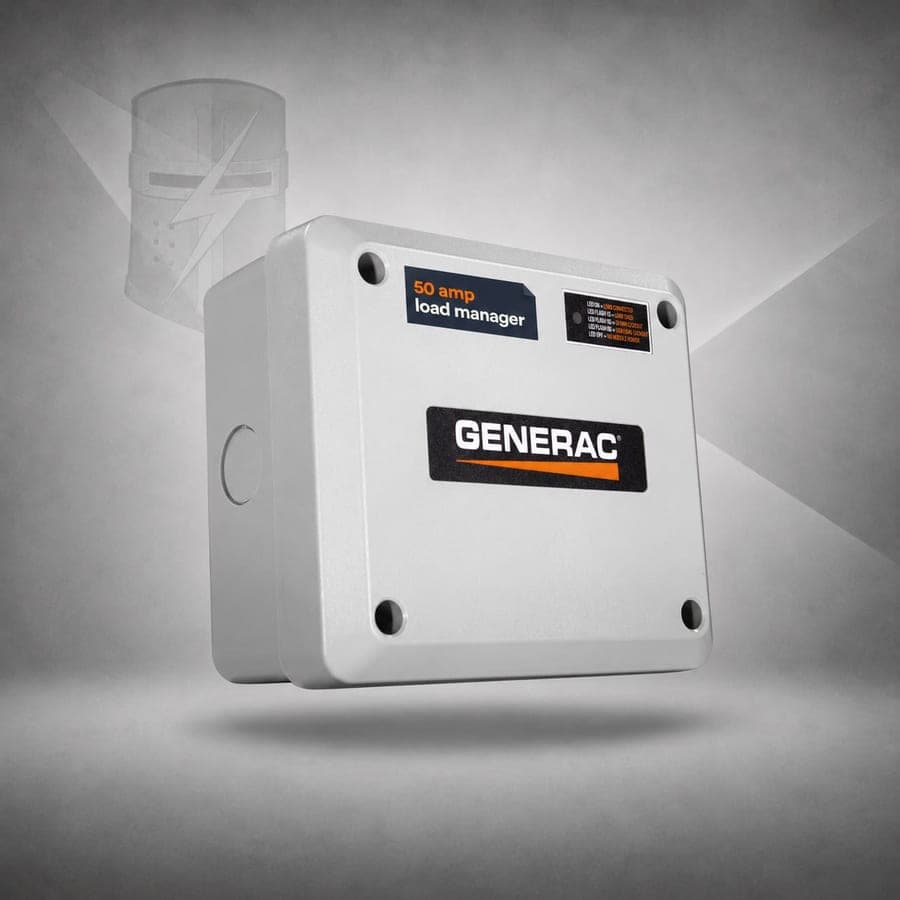
- Generac smart management moduleOne module per large load, rotating them so none of them collide.
 Kohler load shed moduleKohler’s equivalent, wired into the transfer switch rather than the panel.
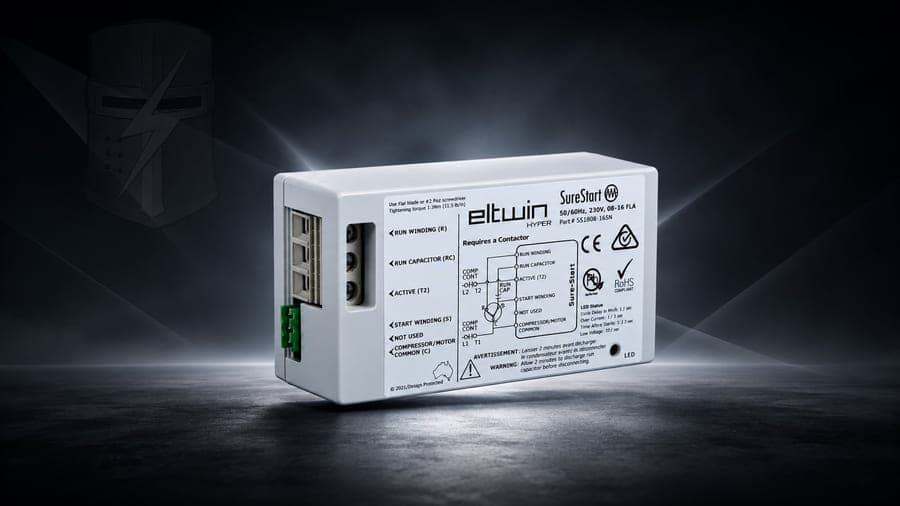 SureStart soft startCuts an air conditioner’s starting draw instead of managing around it.
 ecobee controlHolds HVAC back during a start sequence, so the compressor is not the first thing to fight.
Load management questions
What people ask once they see the numbers
What is the difference between load shedding and load management?
Load shedding is reactive. The generator or inverter approaches its limit and something gets dropped to keep the system from tripping. Load management is proactive. Priority is decided in advance, so the equipment you nominated as important simply gets first call on available power and the rest waits its turn. Most good systems use both, but a design built on management alone is a great deal more pleasant to live with.
Will load management really let me buy a smaller generator?
On most homes with two large loads, yes. Generators are sold in size steps rather than on a continuous scale, and a whole-home load calculation frequently lands just above one of those steps because of two things that rarely need to run at the same instant. Managing them drops you back a class. The saving shows up in the machine, sometimes in the transfer switch, and occasionally in the gas supply feeding it.
What is a soft starter and do I need one?
It is a device wired into an air-conditioning compressor that ramps the motor up instead of slamming it across the line. That startup surge, often several times the running current, is what forces generator sizing upward on many homes. Manufacturers commonly cite inrush reductions of up to 70 percent. Not every compressor needs one, so we measure the specific unit rather than assuming.
Which loads normally get managed?
Air conditioning and heat pumps first, because they are the largest and the least likely to be needed simultaneously with a second unit. Then electric water heating, well pumps, pool equipment, electric ranges and dryers, EV charging, and shop or outbuilding circuits. Lights, refrigeration, networking and medical equipment stay unmanaged. Nothing important is ever on the list.
Will I notice the system managing loads during an outage?
Occasionally, and rarely in an annoying way. A second air conditioner might wait a few minutes for the first one to satisfy. The water heater might hold off while the oven is on. The pool pump will not run at all until the utility is back. If a house is designed so tightly that management is constantly visible, the system was undersized rather than well managed.
Can load management help me avoid a service upgrade?
Sometimes, yes. If the constraint is that two large loads could theoretically run together rather than a genuine shortage of capacity, an energy management system that prevents that overlap can keep an existing service within its limits. This comes up most often with EV charging on a 100 or 125 amp service. It is not universal, and it takes a load calculation to answer.
Can this be added to a generator I already own?
Usually. Smart management modules, essential-load subpanels and soft starters can all be retrofitted to a working system. If your existing generator bogs down or trips when the air conditioning starts, or you have added a shop or an EV since it went in, that is a load-management problem and it is nearly always cheaper to solve than replacing the machine.
Related
Keep reading
- Generator SizingThe calculation load management is designed to change.
- Standby Generator InstallationWhere a smaller, better-managed machine saves real money.
- Automatic Transfer SwitchesWhole-home versus essential-load configurations explained.
- Home Battery BackupWhere managed loads buy runtime as well as headroom.
- Electrical Panel UpgradesSometimes management is the alternative to a service upgrade.
- EV Charger InstallationThe one large load that can always wait until midnight.
Two ways to start
Which one are you?
Need a generator
We start with what has to keep running at your property — the well, the AC, the freezer, the shop — and size the system around it. You get a written proposal with the equipment, the electrical work and the site prep all in one number.
Already own one
Repair, diagnostics and scheduled maintenance for Generac, Kohler and Briggs & Stratton systems — including units another company installed. Tell us the brand and what it is doing and we will bring the right parts.