
Electrical services
Electrical Panel and Service Upgrades
The panel is the part of the house nobody thinks about until something depends on it. A generator, an EV charger or a second HVAC system will each find its limits fast.
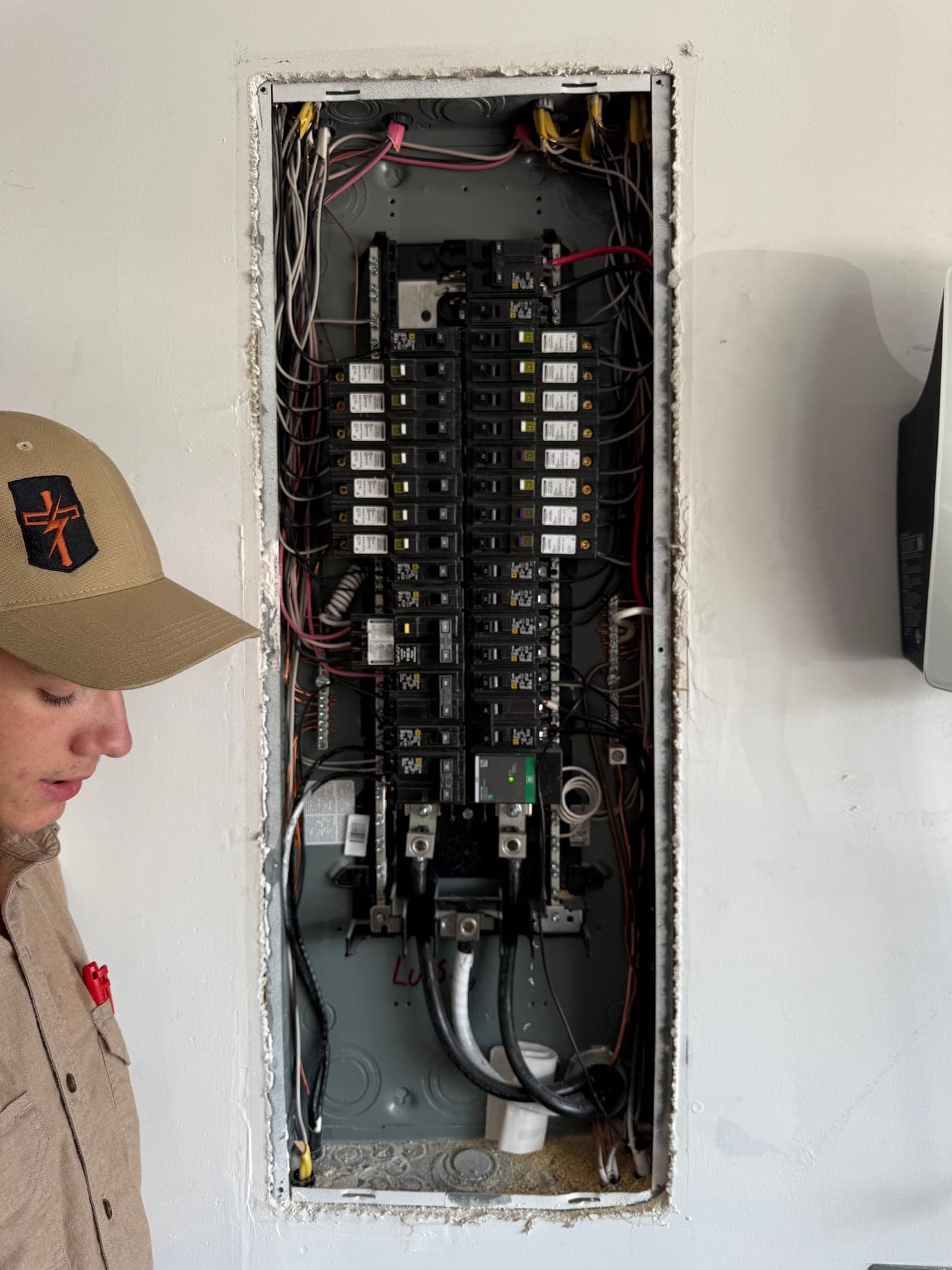
Diagnosis first
Signs your panel is at its limit
Some of these are urgent. Most are just the house telling you it has more equipment than it did when the panel was installed.
Breakers you have learned to work around
Not running the microwave and the toaster together is not a quirk. It is a circuit at capacity, and it usually points at a panel with nowhere left to expand.
Lights dim when the AC starts
A brief dip is normal on a big compressor. A pronounced, repeatable dim across the house suggests a service or connection problem worth measuring rather than living with.
No spare slots, or doubled-up breakers
Two conductors under a breaker not listed for it is a common shortcut in older panels. It is also the point where the next addition has nowhere to go.
A fuse box, or 60 to 100 amp service
Perfectly adequate for a 1965 house. Considerably less so once you add central air, an electric range, a well pump, a shop and eventually a vehicle that charges overnight.
Heat, scorch marks or a burning smell
This one is not a planning conversation. Discoloured breakers, a warm panel cover or any smell of hot plastic should be looked at promptly rather than scheduled around.
A known-defective panel brand
Federal Pacific Stab-Lok, Zinsco and Challenger equipment carries a long-documented history of breakers failing to trip. Worth an evaluation, and insurers increasingly ask.
Capacity
100 amps, 200 amps, and what the difference buys you
Most houses in this part of Texas built before the mid-1980s came with 100 amp service, and for the loads of that era it was correct. Then the house gained central air conditioning, an electric water heater, a well pump, a shop out back, and now a vehicle that wants 40 or 48 amps for six hours a night.
Two hundred amp service is the common upgrade, and for a typical modern home with one or two HVAC systems it usually resolves the constraint for good. But the honest version is that the number comes from a calculation, not from a habit. We look at square footage, HVAC, water heating, cooking, the well, the outbuildings and any planned EV charging, and we run it properly.
Two things frequently change the answer. Load management can keep a service within its existing capacity by preventing the biggest loads from running simultaneously, which sometimes removes the need for an upgrade entirely. And a battery or hybrid inverter system can change the calculation in the other direction. Both are worth checking before committing to a service change.
Why it comes up
A generator install is an audit of your service
Homeowners are sometimes surprised when a standby generator quote turns into a panel conversation. It is not an upsell. It is what happens the first time somebody performs a real load calculation on a house and opens the service equipment to look at it.
Four things routinely turn up:
- No room for the transfer switch. An automatic transfer switch has to integrate with the service, and a whole-home configuration in particular needs a clean place to land.
- The calculated load exceeds the panel. Tolerable on the utility, which will happily supply more than the panel should carry. Not tolerable when a generator is carrying the same house.
- Corroded or overheated terminations. Aluminum service conductors with no antioxidant, loose lugs, discoloured bus. Backup power does not create these problems, it reveals them.
- Grounding and bonding that no longer meets code. Standard on older services, and it has to be corrected before a second power source is introduced.
Any of these found during the quote is a good outcome. Found during commissioning, it means a delay and a change order. It is one of the reasons we look at the panel before we price the machine, and why sizing and the electrical assessment happen on the same visit.
How the job runs
From assessment to inspection
- 01
Assessment and load calculation
We inspect the existing service and panel, measure available capacity, review the equipment on the property and document what you plan to add. The calculation drives the recommendation.
- 02
Scope, permit and utility coordination
You get a defined scope and a written price. We pull the permit and coordinate the meter disconnect and reconnect with the utility, which is the step that sets the schedule.
- 03
Installation
Panel or service equipment replaced, circuits transferred and labeled properly, grounding and bonding brought to current code, terminations torqued to specification.
- 04
Inspection and walkthrough
The work is inspected, the service is re-energized, and we walk you through the new panel directory so you know what every breaker actually does.
Two details that sound small and are not. A legible, accurate panel directory is worth more than most upgrades on the day something goes wrong, so we write one properly rather than leaving the manufacturer’s blank card in place. And this is the natural moment to add whole-home surge protection, because the service is already open and current code requires it on new and replaced dwelling services anyway.
A measured word on Federal Pacific, Zinsco and Challenger
These three panel lines come up constantly, and the internet handles the subject badly in both directions. Here is the factual position. Federal Pacific Stab-Lok, Zinsco (also sold as Sylvania-Zinsco) and Challenger equipment have all been the subject of long-running, well-documented concerns about breakers failing to trip under overload or short-circuit conditions. Independent testing and decades of field reporting support that concern. It is not a rumour.
What it does not mean is that your house is about to burn down, or that you should replace the panel tonight. Plenty of these panels have operated for forty years without incident. What it means is that the protective device you are relying on may not do its job when it is finally called on, and you will not know until that moment. There are also practical problems: replacement breakers are scarce, often refurbished, and many insurers now ask about these brands directly at renewal.
Our position is straightforward. We will look at it, tell you what we actually see, and give you a price to replace it. We will not use the brand name as a lever to sell you something you do not need, and if the panel is in good condition and you would rather plan the replacement for next year, we will say so.
Panel questions
What homeowners ask about panel and service work
How do I know whether I need a panel upgrade or a service upgrade?
They are different jobs that often happen together. A panel replacement swaps the breaker enclosure and its guts while the incoming service stays the same. A service upgrade raises the actual capacity coming from the utility, typically 100 amps to 200 amps, and involves the meter, the service entrance conductors and utility coordination. A load calculation tells us which one you need, and sometimes the answer is neither.
Why did my generator quote turn into a panel discussion?
Because a standby installation puts real scrutiny on the service for the first time in decades. The transfer switch has to land somewhere, the load calculation has to reconcile with what the panel can carry, and a bus or breaker that has been quietly marginal on utility power becomes a genuine problem when a generator is carrying the same house. Finding it during the quote is the good outcome.
Is 200 amp service always the right answer?
No, though it is the common one for a house with central air, electric water heating and any prospect of an EV or a shop. Some properties genuinely need more, particularly with two HVAC systems, a well and outbuildings. Others are fine at 100 amps once loads are managed properly. We run the calculation rather than defaulting to the biggest number.
What is the concern with Federal Pacific, Zinsco and Challenger panels?
These panel and breaker lines have a long, widely documented history of concerns about breakers failing to trip on an overload or short circuit. That is the whole issue: a breaker that does not trip cannot do its only job. It does not mean a panel is about to fail, and it is not a reason to panic. It is a reason to have it evaluated, and many insurers now ask about it directly.
How long will my power be off?
For a straightforward residential panel change, most of a working day, with the actual outage window narrower than that. A service upgrade adds a utility disconnect and reconnect, and that step runs on the utility schedule rather than ours. We tell you the realistic window before the day, including the part we do not control.
Does a panel upgrade need a permit and an inspection?
Yes. Service and panel work is permitted and inspected work, and it also requires coordination with the utility for the meter. We handle the permit, the inspection and the utility sequencing as part of the project. Unpermitted service work is a problem that surfaces later, usually at closing or during an insurance claim.
Can I add a subpanel instead of upgrading the main?
Sometimes, and it is often the cheaper answer. If the main service has capacity but the panel is simply out of physical space, a subpanel adds room without touching the meter or the utility. It does not create capacity. If the load calculation says the service itself is the constraint, a subpanel only relocates the problem.
Related
Keep reading
- Generator SizingThe load calculation behind every panel recommendation.
- Load ManagementSometimes the alternative to a service upgrade entirely.
- Whole-Home Surge ProtectionBest installed while the service equipment is already open.
- Automatic Transfer SwitchesThe equipment a panel upgrade usually has to accommodate.
- Standby Generator InstallationWhat most of this work ends up supporting.
- EV Charger InstallationThe load that surprises more panels than anything else.
Two ways to start
Which one are you?
Need a generator
We start with what has to keep running at your property — the well, the AC, the freezer, the shop — and size the system around it. You get a written proposal with the equipment, the electrical work and the site prep all in one number.
Already own one
Repair, diagnostics and scheduled maintenance for Generac, Kohler and Briggs & Stratton systems — including units another company installed. Tell us the brand and what it is doing and we will bring the right parts.