
Electrical services
Level 2 EV Charger Installation
Overnight charging is the whole point of owning an electric vehicle at home. The part that decides whether it works is not the charger, it is the circuit and the panel behind it.
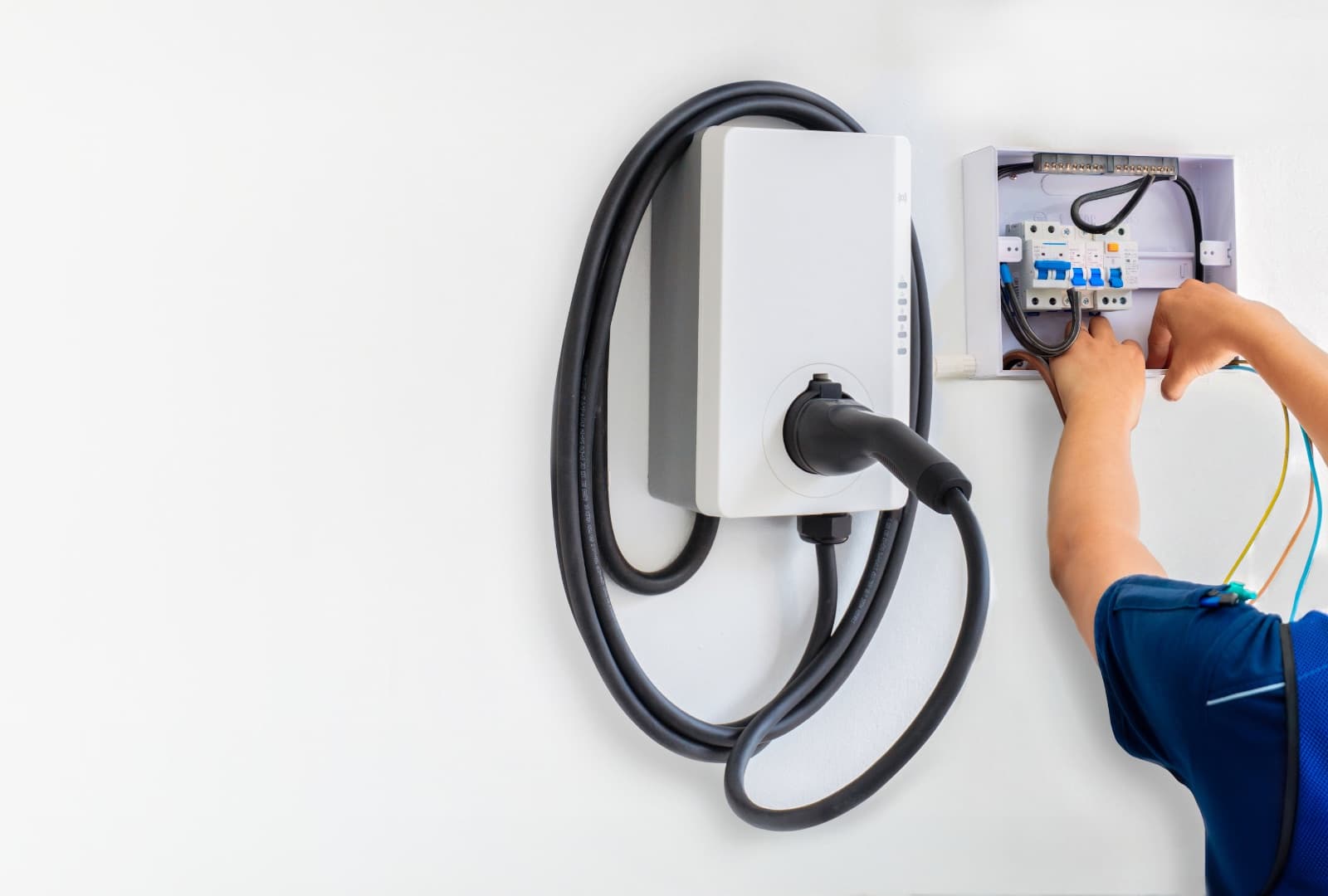
Level 1 versus Level 2
Why a dedicated 240-volt circuit is the whole job
Level 1 charging is the cord that came in the trunk plugged into an ordinary 120-volt outlet. It adds a few miles of range an hour, which is fine if you drive to the mailbox and back and genuinely inconvenient for anyone commuting into Fort Worth. Level 2 runs at 240 volts on a dedicated circuit and turns overnight charging into a non-event.
The equipment itself is the easy part. What takes judgement is everything behind it: how much current the circuit can carry, whether the panel has the capacity to add it, how far the run is, and what happens when the air conditioning starts while the car is charging. That is an electrical design question, and it is the reason this page spends more time on circuits than on chargers.
Circuit sizing
40, 50 or 60 amps
An EV charger is a continuous load, which means it may only draw 80 percent of the circuit rating. That single rule sets every number below.
| Circuit | Maximum charging current | Where it fits |
|---|---|---|
| 40 A circuit | Up to 32 A continuous | The modest option, and often the right one. Adds far more range overnight than most households drive in a day, and fits in panels that cannot support more. |
| 50 A circuit | Up to 40 A continuous | The most common residential installation, and what a NEMA 14-50 receptacle is built around. A good balance of speed against what a typical service can spare. |
| 60 A circuit | Up to 48 A continuous | The fastest most home units go, and it generally has to be hardwired rather than plugged in. Worth it for long daily mileage or a second vehicle, and it needs real panel headroom. |
Bigger is not automatically better. A 60 amp circuit consumes headroom that your service and panel may not have to spare, and most households never use the difference. Work out how many miles you actually drive on a normal day, then pick the circuit that covers it comfortably overnight. Almost everyone lands on 40 or 50 amps and never thinks about it again.
Two more details worth knowing. Most home chargers let you set a maximum output during commissioning, so the unit can be limited to what the service can spare rather than what it is capable of. And a receptacle installation on a 50 amp circuit is capped at 40 amps by the plug standard, so if 48 amps is the goal, the charger is getting hardwired.
Why it is not a DIY job
The load that runs at maximum for six hours
Almost nothing else in a house behaves like this. Ovens cycle, dryers finish, air conditioners satisfy. A charger pulls flat out until the car is full.
Terminations do not get a rest
A slightly loose lug on a circuit that runs at rated current for hours generates heat, and heat loosens the termination further. Correct conductor sizing and torqued terminations are not paperwork, they are the difference between a circuit that lasts twenty years and one that does not.
Manufacturers expect documentation
Tesla, Rivian and Ford are among the manufacturers that expect documented professional installation for home charging equipment warranty purposes. We are a licensed Texas electrical contractor, TECL #41587, working under Master Electrician oversight, and you get the documentation to file.
The panel has to be assessed, not guessed
A load calculation tells you whether the service can carry a continuous 40 to 60 amp addition. Adding one on the assumption that a spare slot equals spare capacity is how main breakers start tripping in August.
Vehicles are unforgiving loads
Poor grounding, voltage drop on an undersized long run, or an unprotected service all reach the vehicle onboard charger eventually. This is one of the reasons surge protection at the service belongs in the same conversation.
Backup power
What an EV charger does to a generator system
This is the part almost nobody raises until afterwards. A charger drawing 40 amps at 240 volts is roughly 9.6 kW of continuous load. On a house with a standby generator, that is comparable to adding a second air conditioner that never satisfies and never shuts off. It will not politely wait its turn on its own.
There are three sensible ways to handle it, and which one applies depends on the property:
- Put the charger on a managed circuit. The most common answer. Load management keeps the charger offline during backup operation so generator capacity goes to the well, the refrigeration and the heat.
- Limit the current during backup. Some chargers can be configured to drop to a lower output when the property is running on generator or battery power, which keeps a slow charge available without dominating the system.
- Include it in the sizing from the start. Reasonable if charging during an extended outage genuinely matters, and it does for some rural households. It costs capacity, so it should be a deliberate decision made during generator sizing rather than a surprise.
If a generator was sized before the vehicle arrived, the arithmetic behind it has changed. That is worth a short conversation rather than finding out during the next maintenance visit that the machine has been running closer to its limit than anyone intended.
How the job runs
From site visit to first charge
- 01
Assessment and load calculation
We look at the panel, the available capacity, the mounting location and the conduit route, and confirm what the vehicle and charger actually require rather than what the box claims.
- 02
Scope and quote
Circuit size, receptacle or hardwired, run length, any panel work and applicable permits, priced before we start. Distance is the variable that moves EV quotes most, so we measure it.
- 03
Installation
Dedicated circuit, correctly sized conductors, clean conduit, proper support and torqued terminations. Mounted where the cable actually reaches the car rather than where the wall was convenient.
- 04
Commissioning and handover
We set the output limit, verify it charges under load, confirm the panel directory is updated, and give you the installation documentation manufacturers ask for.
EV charging questions
What owners ask before the car arrives
What size circuit does my charger need?
The rule that governs it is that a continuous load may only use 80 percent of the circuit rating, because an EV pulls at full current for hours. So a 40 amp charger needs a 50 amp circuit, and a 48 amp charger needs a 60 amp circuit. Most home units let you set the maximum output during commissioning, which means the charger can be dialed to whatever your service can genuinely spare.
Should I use a NEMA 14-50 outlet or hardwire the charger?
A 14-50 receptacle is flexible: you can unplug the unit, take it to a new house or swap it for a different brand. Hardwiring is required above 48 amps, is generally considered the more robust long-term termination, and removes a connection point that heats and cools every day. Current code also requires GFCI protection for receptacle-fed chargers, which occasionally causes nuisance tripping with certain units. We fit either, and we will tell you which we would choose for your installation.
Do I need a panel upgrade to install one?
Not always. If the panel has spare slots and the load calculation shows genuine headroom for a continuous 40 to 60 amp load, a dedicated circuit is all that is required. If the panel is full or the service is at its limit, the options are a service upgrade or an energy management device that prevents the charger from drawing while other large loads are running. The calculation decides, and we run it before quoting.
Why do manufacturers care who installs it?
Because the charger is one of the heaviest sustained loads in the house and the failure modes are expensive. Tesla, Rivian and Ford are among the manufacturers that expect documented professional installation to keep home charging equipment warranty coverage intact. Beyond the paperwork, the reason is practical: a loose termination on a circuit that runs at full current for six hours is a genuine fire risk, and torque specification is not a suggestion.
Can I charge my car from my generator during an outage?
Technically yes on many systems, practically it is usually the wrong priority. A charger drawing 40 amps is comparable to running a second air conditioner continuously, and during an outage that capacity is better spent on the well, the refrigeration and the heat. The usual answer is to put the charger on a managed circuit so it stays offline during backup operation, or set it to a low current limit.
How long does the installation take?
A straightforward garage installation near the panel is usually a single visit. Long conduit runs, detached garages, exterior routing, a panel change or a service upgrade all extend that, and permitting requirements vary by jurisdiction. We look at the route and the panel before quoting so the number you get accounts for the actual distance rather than a best case.
Can a charger be added to a house that already has a generator?
Yes, and it is worth doing deliberately. Adding a large continuous load to a house with an existing standby system changes the arithmetic the generator was sized against. Either the charger goes on a managed circuit that stays offline during an outage, or the load calculation is revisited. It is a short conversation, and it avoids a generator that used to be adequate quietly becoming undersized.
Related
Keep reading
- Electrical Panel UpgradesWhere an EV charger project goes when the service is at its limit.
- Load ManagementKeeping the charger from competing with the generator.
- Generator SizingHow a new large load changes the calculation.
- Standby Generator InstallationBackup power for the house the car is parked at.
- Whole-Home Surge ProtectionProtection for the vehicle onboard charger and everything else.
- Solar InstallationCharging on production you generated yourself.
Two ways to start
Which one are you?
Need a generator
We start with what has to keep running at your property — the well, the AC, the freezer, the shop — and size the system around it. You get a written proposal with the equipment, the electrical work and the site prep all in one number.
Already own one
Repair, diagnostics and scheduled maintenance for Generac, Kohler and Briggs & Stratton systems — including units another company installed. Tell us the brand and what it is doing and we will bring the right parts.