
Generator services
Generator Sizing
How big a generator you need is a question about motors, not square footage. Here is what actually drives the number on a rural Texas property, and how load management can change the answer.
The short answer
Generators are sized by peak demand, and peak demand is mostly motors
Almost every online sizing calculator asks for square footage. It is the wrong question. What a standby generator has to survive is the instant when a motor starts, because motors draw several times their running current for that fraction of a second. Add the running load of the rest of the house underneath that spike and you have the number the unit has to hold without dropping voltage.
On a house in town with one AC unit, city water and gas appliances, that number is modest. On acreage with a submersible well pump, two compressors, a septic aerator, three freezers and a shop, it can be double. Same square footage, completely different machine.
Getting this wrong in either direction costs you. Undersized, the engine bogs, the controller faults, and the system that was supposed to carry the house instead shuts down under it. Oversized, you paid for capacity you will never use and the engine spends its life lightly loaded, which is not good for it either.
Two approaches
Managed whole-home, or essential circuits
These are the two real designs. Everything else is a variation on one of them.
Managed whole-home
The generator backs the entire panel, and a load-management system briefly sheds the heaviest non-critical loads when demand would otherwise exceed capacity. Your water heater or dryer goes quiet for a minute while the air conditioner starts, then comes back. From inside the house it is invisible.
This is how most homes get whole-house coverage without buying the biggest unit on the price list. Every outlet works. Nobody has to remember which circuits are on the backed-up list.
Essential circuits
A dedicated sub-panel carries a defined set of circuits: refrigeration, the well pump, the furnace blower, selected lighting, internet, and any medical equipment. Everything else stays dark until the utility returns.
It costs less up front and uses less fuel. The catch is that the circuit list is decided during design and lived with during the outage, and people are rarely as happy with that list on day three as they were on the day they picked it.
Rural Texas loads
The six loads that dominate the calculation out here
Well pump starting current
A submersible pump is the biggest surge on most rural properties. Horsepower, setting depth and wire run all push the starting figure up, and no water is the outage problem people underestimate most.
Two air conditioning compressors
A lot of houses out here run two systems, or one system plus a mini-split in a shop. If both compressors can call at once, the design has to survive both starting within seconds of each other.
Septic aerator and lift pump
Aerobic systems need the aerator running more or less continuously. Lift and effluent pumps cycle on demand and carry a real starting surge for their size.
Freezers and refrigeration
Individually small, collectively significant, and they all restart at once when power returns. On working properties the contents can be worth more than the generator.
Gate opener and outbuildings
A gate that will not open is a small load and a large inconvenience. Barn lighting, tack room, water troughs and stock tank heaters belong in the inventory too.
The shop
Air compressors, welders and dust collection are the most commonly forgotten loads in the whole exercise. If you intend to keep working during an outage, say so during the assessment.
Reference
Typical household loads, running and starting
A planning reference to help you think about your own property before anyone visits it.
These are typical figures for planning only. They are not a quote, and they are not a substitute for a load calculation.
The ranges below are general industry reference values for common residential equipment, not measurements taken from Armored Power Systems projects. Real figures vary by make, model, age, installation and wiring. Use them to build a rough picture, then let the nameplate data on your own equipment decide the actual design.
| Load | Typical running watts | Typical starting surge | Notes |
|---|---|---|---|
| Central AC, 3 ton (36,000 BTU) | 3,000 – 3,800 W | 9,000 – 12,000 W | A soft start can cut the surge substantially. |
| Central AC, 5 ton (60,000 BTU) | 4,500 – 5,500 W | 14,000 – 18,000 W | Two of these starting together is what breaks a sizing estimate. |
| Submersible well pump, 1 HP, 240V | 1,000 – 1,400 W | 3,000 – 4,500 W | Deeper settings and longer runs push both figures up. |
| Submersible well pump, 1.5 HP, 240V | 1,800 – 2,300 W | 5,000 – 7,000 W | Often the single largest surge on a rural property. |
| Septic aerator (aerobic system) | 100 – 250 W | 250 – 500 W | Small, but it needs to run more or less continuously. |
| Septic lift or effluent pump, ½ HP | 600 – 1,000 W | 1,600 – 2,400 W | Cycles on demand. Skipping it in an outage gets unpleasant fast. |
| Gas furnace blower, ½ HP | 600 – 900 W | 1,800 – 2,400 W | Also runs the air handler in cooling mode. |
| Electric water heater element | 3,500 – 4,500 W | No surge | Resistive. A common candidate for load shedding. |
| Tankless electric water heater | 15,000 – 28,000 W | No surge | Very often excluded from backup entirely. It can outweigh the house. |
| Refrigerator | 150 – 800 W | 1,200 – 2,400 W | Duty cycles, so average draw is far below running watts. |
| Chest or upright deep freezer | 150 – 600 W | 1,000 – 2,000 W | Two or three on a working property adds up. |
| Electric range (oven plus one element) | 3,000 – 5,000 W | No surge | Usually load-shed rather than dropped from the design. |
| Electric clothes dryer | 4,500 – 5,500 W | 6,000 – 7,000 W | A prime load-shedding candidate. |
| Pool pump, 1 HP | 1,000 – 1,500 W | 2,500 – 3,500 W | Frequently excluded, or shed during an outage. |
| Automatic gate opener | 150 – 400 W | 600 – 1,000 W | Small load, high annoyance if it is missed. |
| Shop air compressor, 5 HP | 3,000 – 4,000 W | 7,000 – 10,000 W | Shop loads are the most commonly forgotten part of the calculation. |
| Lighting, outlets, networking, controls | 1,000 – 2,500 W | No surge | Includes internet, security, well controls and thermostats. |
One thing the table cannot show you is timing. Total running watts across a whole house is a misleading number, because those loads are not all on at the same moment. What matters is the worst realistic overlap, which is why the calculation is done by a person walking the property rather than by adding up a column.
Load management
How a smaller generator covers a bigger house
Load management is a controller that sits between the generator and your heaviest circuits. It watches what the engine is being asked to do and, when demand approaches capacity, drops the lowest-priority loads for as long as it takes. Water heater first, then the dryer, then the range, in whatever order you set during design.
The result is that peak demand never actually happens. The generator only has to cover the loads that genuinely coincide, which is a much smaller number than the theoretical maximum. In practice this often moves a house down a generator size, and the saving is usually larger than the cost of the modules.
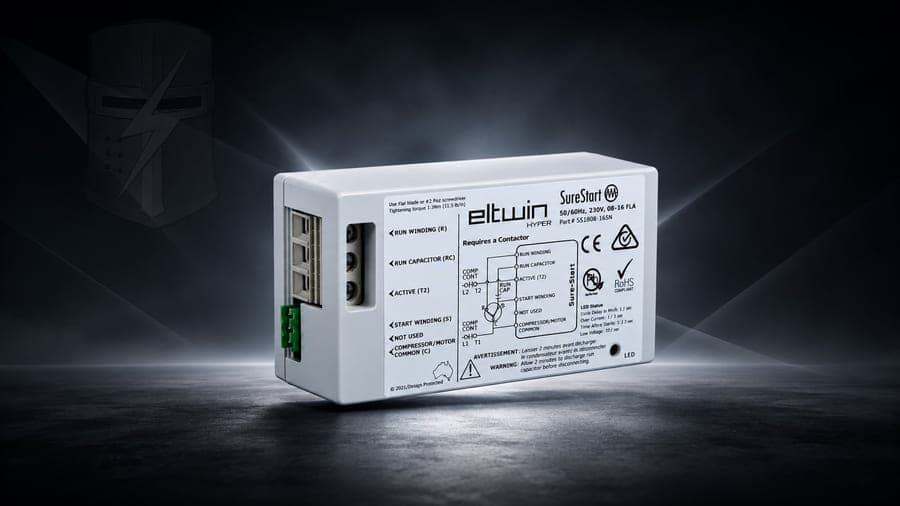
Soft starts do the same job from the other direction, by reducing the inrush current an air conditioning compressor demands at startup instead of shedding something else to make room for it. On a two-compressor house they are frequently the cheapest fix in the whole design.
We cover the hardware in more detail on load management, and how the shedding priority interacts with the automatic transfer switch.
The real thing
What a proper load calculation involves
- A walk of the property. Main service and meter, panel condition and available capacity, grounding, and the physical routes for fuel and conduit.
- A nameplate inventory. Every significant load recorded from its own data plate rather than from a generic table, including well pump horsepower and, where we can establish it, setting depth.
- A worst realistic case. Not everything at once, which nobody experiences, but the combination that genuinely happens: a compressor starting while the well pump is running and the oven is on.
- A fuel-capacity check. Whether your gas meter and service line can deliver what the unit demands, or what tank and regulator a propane installation needs.
- A written recommendation. A unit sized slightly above peak demand, the assumptions we made, and what changes if you add load management or soft starts.
That document is also what makes an estimate comparable. If you are getting quotes from more than one contractor, ask each of them for the load calculation behind the size they recommended. It is a fast way to see who did the work.
Ready to get real numbers for your property? Start with an estimate request, or read what happens next on the standby generator installation page. If your panel is already at capacity, an electrical panel upgrade may need to come first.
Common questions
Generator sizing questions
Starting watts, load shedding, whole-home versus essential circuits, and why square footage keeps coming up.
What size generator do I need for a 2,000 square foot house?
There is no honest answer to that question as asked, because square footage is not what a generator carries. Two houses the same size can differ by 12 kW depending on whether they are on a well, how many air conditioning compressors they run, and whether the water heater and range are electric or gas. The number comes from a load calculation, not a floor plan.
What is starting wattage, and why does it matter so much?
Anything with a motor draws several times its running current for the fraction of a second it takes to spin up. A well pump that runs on 1,200 watts might pull 4,000 for that instant. A generator has to hold voltage and frequency through that surge or the engine bogs and the controller faults. On rural properties, the surge total usually sets the generator size, not the running total.
Can load management let me buy a smaller generator?
Often, yes, and it is one of the more cost-effective decisions in the whole project. Load management watches what the generator is doing and briefly drops the biggest non-critical loads when demand spikes, then puts them back. The water heater going off for ninety seconds while the AC starts is invisible to you. Paying for the next generator size up is not.
Should I back up the whole house or just the essential circuits?
Managed whole-home is the most common choice now, because load management makes it affordable. Essential-circuits designs still make sense on a tight budget, on a property with a genuinely oversized electrical load, or where natural gas capacity limits the unit you can feed. The trade is that the sub-panel decides in advance which outlets work, and people are rarely happy with that list two days into an outage.
Does a soft start really help my generator run the air conditioner?
Yes, in many cases. A soft start ramps the compressor up instead of slamming it on, which cuts the peak inrush current significantly. On a house with two compressors, adding soft starts can be the difference between needing the next size up and not. We look at it as part of the design rather than as an upsell after the fact.
Does propane or natural gas change the size I need?
It changes the output side of the equation. Propane carries more energy per unit than natural gas, so the same engine produces slightly more peak power on LP. It also matters whether your gas meter and service line can actually deliver the volume the generator wants. We check the fuel path before finalizing the unit, because a correctly sized generator on an undersized gas line behaves like an undersized generator.
Can I add a battery instead of a bigger generator?
Sometimes that is the better system. A battery covers the instant transition and quiet overnight loads, while the generator handles extended runtime and the heavy motor starts. On properties with a lot of surge but modest sustained draw, pairing the two can be more useful than simply buying more engine.
What does a load calculation actually involve?
A walk of the property, an inventory of every significant load with nameplate data, a review of the panel and existing service, and a look at the realistic worst-case combination rather than a theoretical one. On a well property we pay particular attention to pump horsepower and setting depth. The output is a peak demand figure, a recommended unit size slightly above it, and a written note of what we assumed so you can challenge it.
Related
Keep reading
- Load ManagementThe hardware that lets a smaller unit cover a bigger house.
- Automatic Transfer SwitchesWhole-home versus essential-circuit panels, and how shedding priority is set.
- Standby Generator InstallationWhat happens after the sizing is settled.
- Electrical Panel UpgradesWhen existing service capacity limits the design.
- Home Battery & Energy StoragePairing storage with a generator instead of buying more engine.
- What Size Generator Do I Need?The longer read, with worked examples for Texas properties.
Two ways to start
Which one are you?
Need a generator
We start with what has to keep running at your property — the well, the AC, the freezer, the shop — and size the system around it. You get a written proposal with the equipment, the electrical work and the site prep all in one number.
Already own one
Repair, diagnostics and scheduled maintenance for Generac, Kohler and Briggs & Stratton systems — including units another company installed. Tell us the brand and what it is doing and we will bring the right parts.