
Electrical services
Whole-Home Surge Protection
Most of what kills electronics in North Texas is not a dramatic lightning strike. It is the utility switching lines back and forth on a summer afternoon, a few hundred times a year.
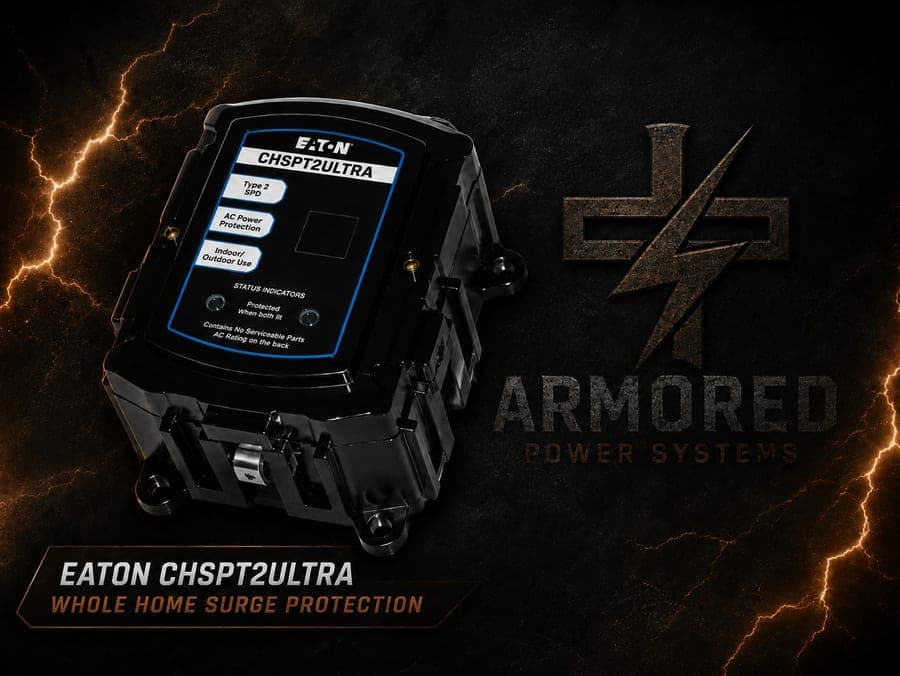
What is really happening
Your electronics are not dying from one big event
A surge is a brief spike in voltage. Long enough to punch through the insulation inside a control board, short enough that nothing else in the house reacts. Homeowners tend to picture lightning, and lightning does contribute, but the routine damage comes from somewhere less dramatic.
Distribution circuits out here use reclosers, which open and reclose in quick succession when a fault clears itself, which is exactly what happens when a branch comes off a tree or a bird finds the wrong two conductors. Capacitor banks switch to hold voltage on hot afternoons. And the single roughest moment on any circuit is power returning after an outage, when load reconnects all at once across a whole neighborhood.
Inside the house, your own equipment adds to it. Every time a well pump, a compressor or a refrigeration unit shuts off, the collapsing magnetic field puts a spike back on the wiring. None of these individually destroys anything. Cumulatively, they are why a variable-speed HVAC control board fails at year six instead of year fifteen.
Layered protection
One device is not a strategy
Surge protective devices are categorized by where they belong in the system. Each type is designed to hand off to the next one.
Type 1
Line side of the service disconnect, at the meter or service entrance
Takes the largest transients before they reach the panel, including the energy that arrives from the utility side during switching events and nearby lightning activity.
Type 2
Load side of the service disconnect, at the main panel
The workhorse. Clamps what gets past the first layer and handles surges generated inside the house by motor loads cycling on and off.
Type 3
At the equipment, downstream of the panel
Point-of-use devices for the things you would actually miss: the office, the entertainment equipment, the well controller, the network gear. Rated for a lower let-through voltage than a panel device.
The reason you need more than one is physics rather than salesmanship. A device sized to absorb a large event cannot also clamp tightly, so it lets a residual voltage through, and that residual is still well above what a sensitive circuit board wants to see. The service-entrance device handles the magnitude. The point-of-use device handles the precision. Together they get the let-through voltage down to something the equipment can live with.
Recent editions of the National Electrical Code require surge protection on new and replaced dwelling services, so if you are already looking at a panel or service upgrade, a device at the service entrance is part of that work rather than an extra.
The natural moment
Why we bring this up during a generator install
The labor is already happening
Installing an automatic transfer switch means the service equipment is open, the panel is de-energized and a licensed electrician is standing in front of it. Mounting and wiring a service-entrance protective device at that point adds very little. Coming back to do it as its own visit costs considerably more for an identical result.
A backup system is worth protecting
A modern standby generator is a computer with an engine attached. Controllers, transfer switch logic, battery chargers and monitoring boards are all electronics on the same service as everything else. The machine you bought so the house survives a storm should not itself be a storm casualty.
Transfer events are surge events
Every outage now involves two switching moments at your property instead of one: the transfer to generator power and the transfer back when the utility returns. Both are exactly the sort of event protection is designed around.
It gets checked on maintenance visits
Protective devices are consumable. If you are on a maintenance plan, the technician who is already there for the generator checks the status indicator instead of leaving you to remember it.
What it covers
The equipment nobody thinks of as electronics
When people picture surge damage they picture a television. In practice the expensive failures are the hardwired equipment, which is exactly what a plug-in strip cannot help with:
- Variable-speed HVAC control boards and communicating thermostats
- Well pump controllers and constant-pressure drives, which are not cheap and are not quick to source
- Solar inverters and microinverters, and battery system electronics
- Generator controllers, transfer switch logic and monitoring modules
- Appliance control boards in ranges, ovens, refrigerators and washers
- Garage door openers, irrigation controllers, gate operators and pool equipment
- Network equipment, security systems and anything with a permanent power supply
On a rural property, the well pump alone justifies the conversation. If you also have a solar array or battery storage, there is a meaningful amount of electronics hanging off that service, and none of it is plugged into anything you could put a strip on.
Honest limits
What surge protection does not do
A direct lightning strike to the structure is beyond what any service-entrance device is rated to absorb. Nothing at your panel changes that, and any contractor telling you otherwise is describing a product that does not exist. What protection handles well is induced energy from nearby strikes and the switching transients that make up the overwhelming majority of real events.
Protective devices also wear out. They absorb energy and degrade doing it, which is why quality equipment has a status indicator on the front. A device installed in 2019 that has taken a few hard events may be doing nothing at all today. Checking it takes ten seconds, and it is part of every maintenance visit we make.
And protection is not a substitute for the rest of the electrical system being sound. Poor grounding, loose terminations and a panel at the end of its life will undermine a good device. We look at those first, because a protector bolted onto a bad service is decoration.
Surge protection questions
What homeowners ask before adding protection
Is one device at the panel enough?
It is the most important single device, and it is not the whole answer. A service-entrance device is sized to absorb large events, which means it lets a certain voltage through to protect itself. That remaining let-through is still more than sensitive electronics enjoy. A point-of-use device downstream clamps tighter on the small stuff. The two are designed to work as a pair, not as alternatives.
Do power strips count as surge protection?
A quality point-of-use protector has a real role, and a cheap strip from a supermarket does not. Look for a UL 1449 listing, a stated joule rating and an indicator that shows when the protection has been used up. What none of them can do is protect a hardwired air conditioner, an oven, a well pump or a furnace control board, because nothing about those is plugged into a strip.
What actually causes surges in Texas?
Lightning gets the blame, and it does contribute, but most of the damage we see comes from ordinary utility behavior. Reclosers on distribution lines open and close in rapid sequence when a fault clears. Transformers and capacitor banks switch. Power returning after an outage is a particularly rough moment. Add motor loads cycling inside the house and you have a steady diet of small transients.
Does a surge protector wear out?
Yes, and this is the detail nobody mentions at the point of sale. The internal components absorb energy and degrade with every event they handle, which is why quality devices have status indicators. A protector with a dark indicator is a piece of trim. We check them during scheduled maintenance visits rather than assuming they are still doing something.
Will surge protection stop a direct lightning strike?
No, and anyone claiming otherwise is selling. A direct strike to the structure carries energy no service-entrance device is rated to absorb. What surge protection handles well is the far more common case: energy induced onto lines by a strike some distance away, and switching transients from the utility. That covers the large majority of real-world damage.
Why install it when the generator goes in?
Because the service equipment is already open, the labor overlaps almost completely, and a backup system gives you a second reason to care. A transfer switch means two sources feeding the same house, and the moment of transfer back to utility power is exactly the kind of event surge protection exists for. Adding it later costs more for the same result.
Related
Keep reading
- Electrical Panel UpgradesWhere service-entrance protection is normally installed.
- Standby Generator InstallationThe project that usually opens the service in the first place.
- Generator MaintenanceWhen we check whether your protective device is still working.
- Automatic Transfer SwitchesTwo power sources, two switching events, one more reason to protect.
- Home Battery BackupStorage electronics that live on the same service as everything else.
- Maintenance PlansScheduled visits that keep consumable protection accounted for.
Two ways to start
Which one are you?
Need a generator
We start with what has to keep running at your property — the well, the AC, the freezer, the shop — and size the system around it. You get a written proposal with the equipment, the electrical work and the site prep all in one number.
Already own one
Repair, diagnostics and scheduled maintenance for Generac, Kohler and Briggs & Stratton systems — including units another company installed. Tell us the brand and what it is doing and we will bring the right parts.