
Generator services
Standby Generator Installation
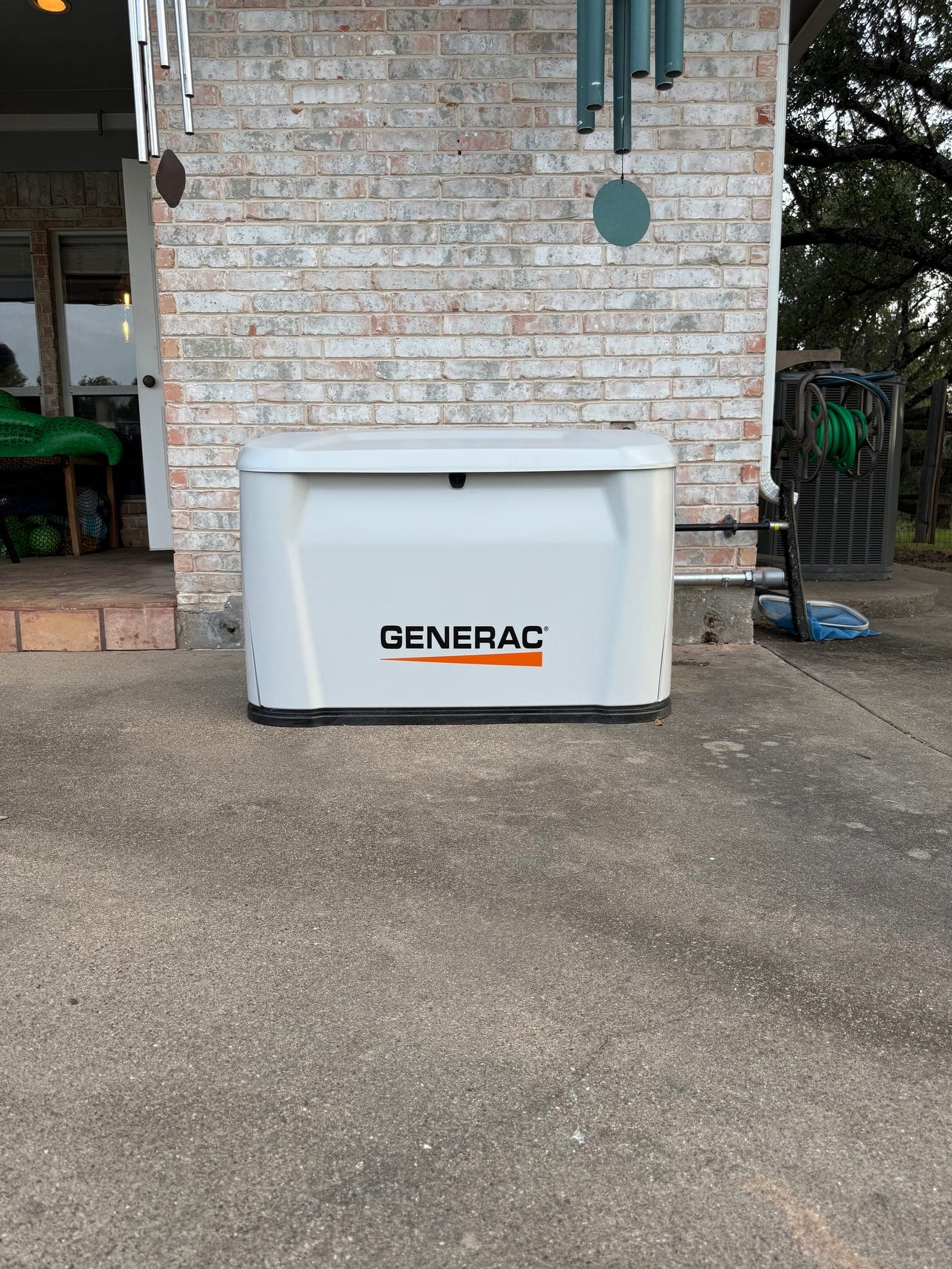
A permanently installed generator that starts on its own when the utility drops, carries the house until power returns, and shuts itself down afterwards. We design it, permit it, install it and test it under load.
What it is
A standby generator is part of the house, not a machine you drag out of the shed
It sits on a pad outside, wired permanently to your electrical service and plumbed to natural gas or a propane tank. An automatic transfer switch watches the utility around the clock. When power fails, the switch isolates your house from the grid, starts the engine, and moves your loads over. When the utility comes back and stays back, it transfers you home and lets the engine cool down.
You do not carry fuel in the dark. You do not run extension cords through a window. You do not have to be home at all. The difference between a portable and a standby unit is not really horsepower, it is that one requires a person and the other does not.
The equipment is the easy part. What makes the system work is the electrical design underneath it: the load calculation, the transfer switch selection, the panel it lands on, and whether load management is doing anything useful.
What it keeps running
The loads people actually care about at hour six
Nobody buys a generator for the lights. They buy it for the things that get expensive or dangerous when they stop.
Water
On a private well, no power means no water. No showers, no toilets, no livestock troughs, no fire protection. The pump is usually the single most demanding load on a rural property.
Heating and cooling
A house in a July outage climbs into the nineties inside within hours. A house in a February freeze drops toward pipe-burst territory. Keeping the HVAC running is how you avoid a repair bill that dwarfs the generator.
Refrigeration
A full deep freezer and a refrigerator represent real money, and on a working property they can represent a season of beef. Both come back on automatically.
Septic and lift pumps
Aerobic systems need their aerator running. Lift and effluent pumps need to keep cycling. Neither is optional for long.
Medical equipment
Oxygen concentrators, CPAP machines, powered mobility and refrigerated medication all assume the wall outlet works. If someone in the house depends on one, that shapes the design.
Work that happens at home
Internet, networking, gate openers, shop tools, incubators, compressors. If your income runs through the property, the outage costs more than comfort.
The install
Four steps, and you know what happens in each one
This is the same process we run on every project, whether it is a 200 amp house in town or a ranch with a shop and two wells.
- 01
Consultation & power assessment
We walk the property. Main service and meter, panel condition, grounding, circuit inventory, gas line or propane tank location, and where a unit can legally and sensibly sit. Then we identify the loads that actually have to keep running and what they draw when they start, not just when they idle.
- 02
Custom system design & estimate
Generator placement that clears the code-required distances from windows, doors and vents. Wire and fuel routing mapped before anyone digs. You get a flat-rate, line-item estimate covering equipment, electrical work and site prep in one number rather than a stack of allowances.
- 03
Professional installation & integration
We handle the municipal permitting and the utility coordination. Excavation and a steel-reinforced concrete pad. The automatic transfer switch goes in inline with the breaker box. Heavy-gauge copper wiring runs in conduit, dressed straight and parallel to the structure rather than draped across it.
- 04
Long-term service & protection
We finish with a live simulated grid failure so you watch the system pick the house up under real load, register the warranty with the manufacturer, and walk you through the controller, the manual override and the disconnect. Your first full year of routine maintenance is included.
Fuel
Natural gas or propane
Both work. The right answer usually comes down to what is already at the property and how long you expect an outage to last.
Natural gas
Connects to the utility line already feeding your house. There is no tank to watch and no delivery to schedule, so an extended outage does not turn into a fuel-logistics problem. The catch is capacity: the meter and the supply line have to be sized to carry the generator on top of your existing gas appliances, and on older services that means a meter upgrade. We size the fuel path during the assessment, not after the unit is set.
Natural gas carries slightly less energy per unit than propane, so the same engine makes a little less peak power on it. We build that into the load calculation rather than pretending the nameplate is fuel-agnostic.
Propane
The normal choice on rural acreage where there is no gas main, and an easy one if you already keep a tank for the house. Propane is denser, so the engine reaches its highest rated output on it, which helps when a deep well pump has to start against a full house.
Your runtime is capped by tank size, commonly 250 to 500 gallons or more for a standby installation. In a long outage you are watching a gauge and coordinating a delivery, so tank sizing is part of the design conversation rather than an afterthought.
Sizing
Square footage does not size a generator
A 2,400 square foot house on city water with one AC unit and a gas furnace is a completely different machine from a 2,400 square foot house on a well with two compressors, a septic aerator and a shop. The number that matters is peak demand, and the biggest contributor to peak demand is motor starting current.
Our sizing sequence is simple enough to explain in three lines:
- Inventory. Every major appliance, HVAC unit, pump and safety system on the property, with running and starting figures.
- Peak demand. The worst realistic combination. The AC compressor kicking in while the well pump is already running and the oven is on.
- Capacity matching. A unit sized slightly above that peak, so the engine is not living at its limit every time something cycles.
Our sizing page goes deeper, including a reference table of typical running and starting watts. If the number comes out awkwardly high, adding load management or an HVAC soft start can often let a smaller, cheaper unit cover the same house.
Scope
What is included in the installation
One contract covers the equipment, the electrical work, the site prep and the paperwork. There is no second trade to hire.
A real load calculation
Continuous draw and motor-starting surges mapped across the property, so the unit is matched to demand instead of to a square-footage rule of thumb.
Permitting and inspections
Municipal electrical and structural filings, clearance checks and inspection scheduling, handled by our office.
Utility coordination
Meter pulls, temporary de-energization and any coordination the utility requires to land the transfer switch safely.
Fuel supply sizing
Regulator selection and line sizing matched to the generator’s demand, whether that is a natural gas meter upgrade or a propane tank and regulator set.
Excavation and a concrete pad
A level, steel-reinforced foundation that keeps the equipment out of ground moisture and off shifting soil.
Wiring in rigid conduit
Copper conductors run in conduit between the generator, the transfer switch and the panel, with clean terminations and labeled circuits.
Automatic transfer switch
Installed inline with the breaker box so the house is isolated from the utility before the generator ever picks up load.
Live startup and load testing
A simulated outage under real load to verify voltage and frequency stability, transfer timing and retransfer behavior.
Warranty registration
System data logged with the manufacturer on commissioning day, so coverage starts clean and documented.
A walkthrough that sticks
Enclosure locks, manual override, status lights, what the exercise cycle sounds like, and what to do if you see an alarm.
Two things sit outside that list often enough to mention. If your service or electrical panel needs upgrading to accept the generator connection safely, that is quoted as its own line. And optional additions like whole-home surge protection or remote monitoring are shown separately so you can decide rather than discover them in a total.
Common questions
Standby generator installation questions
The questions homeowners ask us on the first visit, answered the way we answer them in person.
How does a standby generator know the power is out?
The automatic transfer switch continuously watches utility voltage on the incoming service. When it drops out or falls outside tolerance for a set number of seconds, the switch signals the generator to start, waits for the engine to stabilize, opens the utility connection and closes onto generator power. When the utility returns and holds, it transfers back and lets the engine run a cool-down cycle before shutting off. Nobody has to be home.
Natural gas or propane — which is better for a standby generator?
Natural gas is the easier answer if you already have reliable gas service, because there is no tank to monitor and no delivery to schedule. The meter and supply line have to be sized to carry the generator on top of the house, which sometimes means a meter upgrade. Propane suits rural properties with no gas service, and it carries slightly more energy per unit, so the same engine typically makes a little more power on LP than on natural gas. The trade is that your runtime is limited by tank size, commonly in the 250 to 500 gallon range for a standby set-up.
How loud is a home standby generator?
Modern air-cooled units from Generac and Kohler run at roughly 65 to 67 dB(A) measured from about 23 feet under normal load. That is comparable to a central air conditioning condenser, and it is well inside typical municipal noise ordinances. The weekly exercise cycle is short and can usually be scheduled for a time of day that suits you.
Do I need to upgrade my electrical panel first?
Sometimes. Older panels, panels with no spare capacity, and panels from manufacturers with known safety recalls can all force the issue. We inspect the service and the panel during the assessment and tell you before the estimate, not after the excavator arrives. If an upgrade is needed we handle it as part of the same project.
What size generator do I need for my house?
Size comes from your electrical load profile, not your square footage. Two air conditioning compressors and a submersible well pump can dominate the calculation on a rural property, because motors draw several times their running current for the instant they start. We inventory the loads, calculate peak demand with the worst realistic combination running, and match a unit slightly above that so the engine is not straining at full tilt every time the AC cycles.
Can a standby generator run my whole house?
Yes, and it is the most common configuration we install. The alternative is an essential-circuits design, where a dedicated sub-panel carries refrigeration, well pump, select lighting, internet and medical equipment while high-draw items like a pool pump or a second heating zone stay off. Load management sits in between: it backs the whole house but sheds the biggest loads for a moment when they would otherwise overlap.
Is maintenance included after installation?
Every new generator installation includes your first full year of routine maintenance, free. After that you can move onto an annual or bi-annual plan, or call us as needed. Manufacturers expect documented service to keep a factory warranty intact, so the paperwork matters as much as the oil change.
Is financing available?
Financing is available through multiple lenders, subject to credit approval. We would rather you get the estimate first and then look at terms against a real number, so the system is sized around your property rather than around a monthly payment.
Related
Keep reading
- Generator SizingLoad calculations, managed whole-home designs, and a table of typical household loads.
- Automatic Transfer SwitchesService-rated versus non-service-rated, and what decides which circuits stay on.
- Generac GeneratorsAir-cooled and liquid-cooled home standby, from Generac Dealer #1033043.
- Kohler GeneratorsKohler home standby systems, and an honest comparison with Generac.
- Maintenance PlansWhat happens after the first free year of service.
- Electrical Panel UpgradesWhen the panel has to be addressed before the generator goes in.
Two ways to start
Which one are you?
Need a generator
We start with what has to keep running at your property — the well, the AC, the freezer, the shop — and size the system around it. You get a written proposal with the equipment, the electrical work and the site prep all in one number.
Already own one
Repair, diagnostics and scheduled maintenance for Generac, Kohler and Briggs & Stratton systems — including units another company installed. Tell us the brand and what it is doing and we will bring the right parts.