
County service area
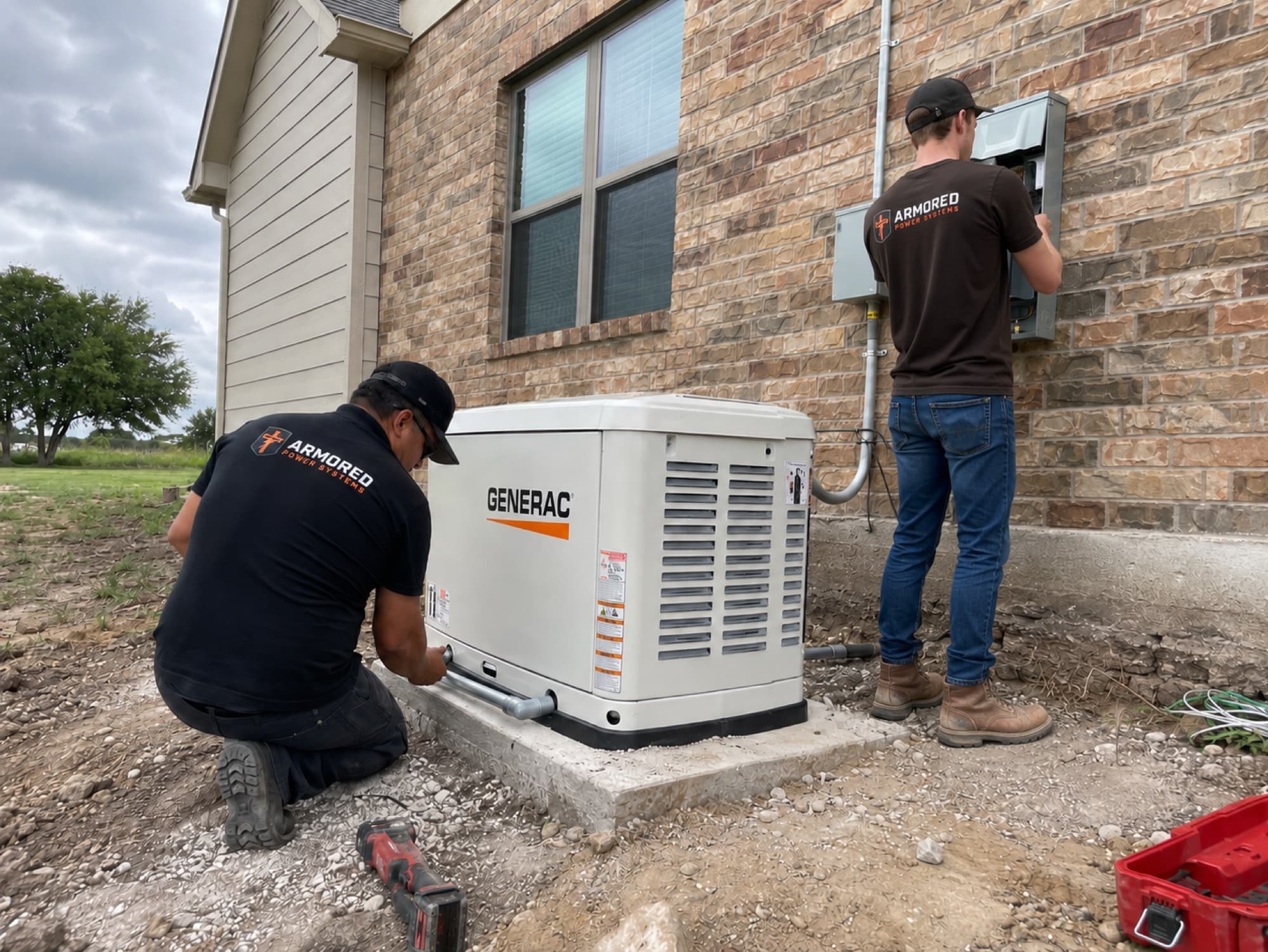
Standby Generator Installation Across Parker County, TX
Nine hundred square miles containing three separate electric regimes, two different soils, eight communities with no gas utility at all, and a county that issues no building permits. A design here is address-specific by necessity.
The thing to understand first
Three electric regimes, inside one county line
Most of Texas has one answer to who owns the wire. This county has three, and they behave differently in an outage, on a bill and on a permit.
| Who | Type | Retail choice | What it means for you |
|---|---|---|---|
| City of Weatherford | Municipal utility | No | The city owns the wire, sets cost-based rates, keeps crews in town and publishes its own service policy governing how a second source of power may be connected. |
| Oncor Electric Delivery | Investor-owned delivery utility | Yes | A retail provider bills you; Oncor delivers and restores. Report outages to Oncor, not to the name on the invoice. |
| Tri-County Electric Cooperative | Member-owned cooperative | No | You are an owner rather than a customer. More than 9,660 miles of distribution line across 16 counties, serving over 105,000 members. |
The cooperative’s roots are older than most of the subdivisions on top of them. It was organized in 1938 near Azle, its federal designation was literally “Texas 101-Parker,” and its first line ran from Weatherford to Azle. Today the outage tracking services follow three separate electric utilities in this county, which is a good indicator of how genuinely divided it is.
What that means commercially is simple. Anyone who writes you a proposal without knowing which of the three you are on has guessed at the outage narrative, the restoration expectation and, in one of the three cases, the permitting path.
Fuel
Natural gas stops at the town limit
Fewer than 8,000 residential gas meters in a county of 148,222 people. That is a verifiable, primary-sourced statement, and it decides the fuel section of nearly every design we do.
Texas Gas Service towns
Weatherford (4,132 residential meters), Aledo (1,058), Hudson Oaks (271), Willow Park (130), Millsap (79), plus Punkin Center and Whitt.
Atmos Energy Mid-Tex towns
Springtown (261 residential), Azle in its Parker County portion (1,492), Reno (44), Sanctuary (34), and two meters in Millsap.
No gas utility at all
Brock, Annetta, Peaster, Poolville, Cool, Garner, Dennis and Tin Top appear nowhere in the Railroad Commission’s city table. Those are propane communities, full stop.
All of those counts come from the Railroad Commission of Texas Table 1A for calendar year 2022. Read against a county population of 148,222 at the 2020 census, the conclusion is unavoidable: this is overwhelmingly a propane and all-electric county with a handful of gassed town centers inside it. Which is why we treat tank sizing, regulator selection and cold-weather vaporization as engineering rather than as a delivery arrangement.
The ground
Sand in the west, clay in the east
Two ecoregions meet inside this county, and they behave differently under a trencher and around a grounding electrode.
Cross Timbers, west and southwest
Sandy loams drained by the Brazos River. This is Brock, Millsap and Dennis country, the same soil the chamber of commerce credits for cushioning cutting horses’ feet. It digs easily and drains fast, and it makes different demands of a grounding system and a pad than heavy clay does.
Grand Prairie, east and central
Drained by the upper tributaries of the Trinity. This is the Weatherford, Hudson Oaks, Willow Park and Aledo half of the county. Clay moves with moisture, which is why a properly formed, steel-reinforced pad is worth the extra hour and a hand-poured slab on grade is not.
Elevations across the county run from 700 to 1,200 feet over 902 square miles of undulating to hilly land. The climate is straightforward and unforgiving in both directions: an average July high of 96°F, an average January low of 34°F, slightly over thirty-two inches of rain a year, and a 225-day growing season. Agriculture here still runs to cattle, dairy, peaches, peanuts, pecans and horses, across 486,658 acres of farm and ranch land. On a working property the load list usually includes a well pump, an aerator and a shop before anyone mentions the house.
Permits and law
A county with no building permits, and one city that is the statutory exception
Unincorporated Parker County
The county states that it does not issue building permits or certificates of occupancy, and there is no zoning outside the cities. Commercial and multifamily projects route through the Fire Marshal. Code, the manufacturer’s manual and contractor licensing carry the weight instead.
Inside most cities
Texas SB 1252 took effect on 1 September 2025 and bars a municipality from regulating the installation or inspection of a residential energy backup system rated at 50 kW or less. SB 1202, effective the same day, allows third-party plan review and inspection with three-business-day approvals.
Weatherford, the exception
The statute preserves that authority for a municipally owned utility inside its service area. Because the city owns Weatherford Electric, it is the exception rather than the rule. Details on the Weatherford page.
None of that changes licensing. All non-exempt electrical work in Texas still has to be performed by licensed electrical contractors and electricians, to the National Electrical Code. Ours is TECL #41587, under Master Electrician oversight. What it does change is speed and cost, and it is worth knowing which regime your address sits in.
Septic is the one county-level approval that always applies. Parker County is the TCEQ-designated authorized agent for on-site sewage facilities, and it issued 1,300 new authorizations in 2024 and 1,266 in 2025, more than twice the volume of Palo Pinto and Erath counties combined. On a septic property the drainfield is usually the constraint that decides where the generator can sit.
Why people here buy standby power
Sixty percent of this county drives somewhere else to work
The county’s economic development council puts it plainly: more than 60 percent of the workforce commutes outside the county, with 1.1 million jobs inside a 45-minute drive. So when a line comes down at five in the morning in February, a large share of these houses are empty, or about to be. Nobody is standing in the garage pulling a starter cord. A permanently installed system with an automatic transfer switch does not need anyone to be home, which is the practical argument out here.
The exposure is not theoretical. On 19 April 2025 the National Weather Service confirmed an EF-1 tornado in this county with peak winds near 110 mph, and in late April 2026 another EF-1 was confirmed near Springtown at around 105 mph. Oncor has noted that ice can multiply the weight of a tree branch up to thirty times, which is what actually brings lines down in a winter storm.
Restoration then follows the same order everywhere: transmission, main feeders, tap lines, and individual service drops last. That sequence is correct because it returns the most people fastest. It also means the meters at the end of a long rural tap wait longest, and no amount of statewide generation capacity changes that arithmetic.
What we do here
Across the whole county
Standby Generator Installation
Whole-home and essential-circuit systems on natural gas or propane, permitted properly for the jurisdiction.
See detailsGenerator Sizing
Load calculations that account for well pumps, septic aerators, shops and two compressors.
See detailsGenerator Repair
Generac, Kohler, Briggs & Stratton, Cummins, Champion and Honeywell, including inherited units.
See detailsCommercial Generators
Shops, clinics, churches, ranches and small facilities across the county.
See detailsElectrical Panel Upgrades
Service capacity for century-old houses downtown and thirty-year-old ranch houses alike.
See detailsAutomatic Transfer Switches
The device that isolates you from the utility before the engine picks up the house.
See detailsHome Battery & Storage
Instant coverage for loads that cannot tolerate a start cycle, paired with a generator.
See detailsMaintenance Plans
The first full year is included with every new install. After that, annual and bi-annual plans.
See details
Nearby
Towns in this county
Each one has its own page, because each one has its own utility, its own fuel picture and its own ground.
- Weatherford, TXThe county seat, and the only municipal electric utility on our map.
- Aledo, TXThe highest gas-meter coverage in the county, inside a school district ten times its size.
- Willow Park, TXRoughly 130 residential gas meters in a city of nearly 5,000.
- Hudson Oaks, TXExplicitly split between Tri-County and Oncor, on the city’s own page.
- Brock, TXNo gas utility at all, and a town that only incorporated in 2016.
- Millsap, TX1.47 square miles of town inside 124 square miles of school district.
- Springtown, TXThe only Atmos town here, straddling the Wise County line.
Common questions
Parker County questions
Utility, fuel, permits and ground, which is the order these projects actually get decided in.
How do I find out which electric utility serves my address?
Read the top of the bill rather than trusting a map. If the bill comes from a retail electric provider you chose, the wires belong to Oncor and outages get reported to Oncor. If it comes from Tri-County Electric Cooperative, you are a member, there is no retail plan to shop, and the co-op restores you. If it comes from the City of Weatherford, the city is your utility for everything. Public territory maps do not resolve this at address level, and we would rather confirm it than assert it.
Is there natural gas at my property?
Piped gas here is a town-limits phenomenon. Texas Gas Service is certificated in Weatherford, Aledo, Hudson Oaks, Willow Park, Millsap, Punkin Center and Whitt. Atmos Energy Mid-Tex serves Springtown, Azle, Reno and Sanctuary. No investor-owned gas utility appears at all for Brock, Annetta, Peaster, Poolville, Cool, Garner, Dennis or Tin Top. Added up, the Railroad Commission records fewer than 8,000 residential gas meters across the county, in a county of 148,222 people at the 2020 census. Most of it is propane or all-electric.
Do I need a county permit for a generator?
Parker County states that it does not issue building permits or certificates of occupancy, and there is no zoning in the unincorporated areas. Commercial and multifamily work routes through the Fire Marshal. Since 1 September 2025, Texas SB 1252 has also barred municipalities from regulating the installation or inspection of a residential backup power system rated 50 kW or under, with an exception for cities that own an electric utility. Weatherford does, so it is the one place in the county where the old process may still apply in full.
Does the ground really change the installation?
It does, and this county is genuinely split. The sandy loams of the Cross Timbers cover the western and south-western county and drain toward the Brazos. The eastern and central county sits in the Grand Prairie and drains into the upper Trinity tributaries. Trenching, backfill, grounding electrode performance and how a pad behaves through a wet winter all differ between those two, which is one reason we walk a property before quoting rather than pricing from an aerial photograph.
How long do outages actually last out here?
It depends which utility you are on, and both publish numbers. In 2021, the Winter Storm Uri year, Tri-County Electric Cooperative reported an average of 1,907.9 minutes per member, close to 32 hours, and Oncor reported 558.8 minutes. In 2024 those were 134.6 and 532.5 minutes respectively. Those figures are filed with the federal government, include major storm days and are reported under different standards, so treat them as directional rather than as a like-for-like race.
Do you cover unincorporated areas and the small communities?
Most of our work is outside city limits. Annetta, Annetta North, Annetta South, Cool, Dennis, Peaster, Poolville, Whitt, Garner, Tin Top, Reno, Sanctuary and Punkin Center are all part of the same county picture: no gas main, a private well or a small water supply corporation, an on-site septic system and a long service drop. If you are near the edge of the county, call and ask rather than assuming, and we will give you a straight answer.
Related
Keep reading
- Standby Generator InstallationThe complete scope of an installation, from load calculation to live testing.
- Generator SizingWhy square footage does not size a generator on an acreage property.
- Commercial GeneratorsStandby power for working properties and small facilities.
- Palo Pinto CountyThe county to the west, with five electric utilities instead of three.
- Erath CountyTwo towns with a gas utility, and the newest housing stock we work on.
- Maintenance PlansAnnual and bi-annual service, county-wide.
Two ways to start
Which one are you?
Need a generator
We start with what has to keep running at your property — the well, the AC, the freezer, the shop — and size the system around it. You get a written proposal with the equipment, the electrical work and the site prep all in one number.
Already own one
Repair, diagnostics and scheduled maintenance for Generac, Kohler and Briggs & Stratton systems — including units another company installed. Tell us the brand and what it is doing and we will bring the right parts.