
Texas grid and storms
Texas Power Outage Preparedness: What the Record Shows
Preparation works better when it is built on the record rather than on a headline. Here is what the documented events actually show, and what to do about them.
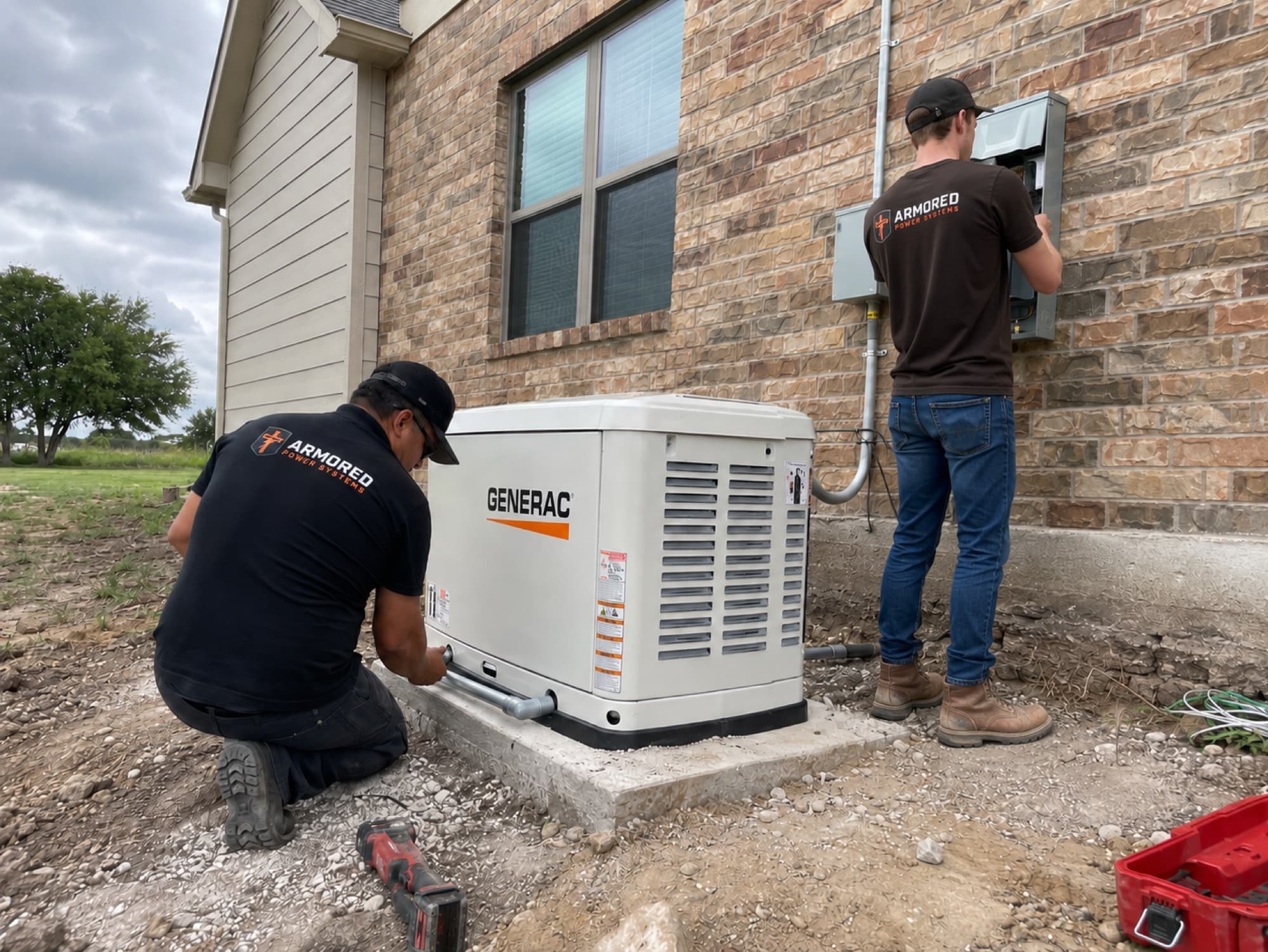
Practical outage preparation for a rural Texas property comes down to four things: water, heat or cooling, food and refrigeration, and communication. Everything else is detail. What makes the planning worth doing is not a prediction about the grid, it is the documented record of what has actually happened here in the last five years.
This page uses sources you can open and read. Where a figure could not be verified against a primary source, it is not here.
What February 2021 actually did
ERCOT’s own event page covers operating days 14 to 19 February 2021. More than 4.5 million Texas customers lost power, and the University of Texas Energy Institute’s analysis of the event records roughly 20,000 MW of rolling blackouts, the largest manually controlled load-shed event in United States history.
The household-level numbers come from the Texas Comptroller of Public Accounts, in an October 2021 review, and they are the figures worth remembering.
- More than two out of three Texans, 69 percent, lost power.
- The average power disruption ran 42 hours, and 31 consecutive hours was typical.
- About 49 percent had disruptions in water service, averaging 52 hours. On a private well, that is the same outage.
- 31 percent had water damage to their home, which in practice means burst pipes.
- Three-quarters had difficulty getting food and groceries.
- Dallas–Fort Worth recorded 139 consecutive hours at or below freezing. Waco Airport recorded 205.
The Texas Department of State Health Services put the final death toll at 246, across 77 counties, with 161 attributed to cold exposure, as reported at the time. More than two dozen people died after prolonged loss of power prevented the use of critical medical equipment. Carbon monoxide poisoning was among the tallied causes, as people ran charcoal grills indoors and vehicles in garages to stay warm. Those two facts are not here for effect. They are the two most concrete reasons that permanently installed backup power and properly vented equipment matter, and they inform two sections further down this page.
The federal follow-up, the FERC and NERC final report released in November 2021, carried 28 formal recommendations on generator winterization and gas-electric coordination.
The honest part: the grid has done better since
Plenty of companies in this industry sell on the premise that February 2021 is about to repeat. The evidence does not support building a plan on it, and a buyer who checks will find that out.
ERCOT handled three freezes in early 2025 without issuing conservation requests. During Winter Storm Enzo in January 2025, ERCOT forecast a peak near 79,000 MW, which would have been the highest wintertime demand on the system, and came through without conservation appeals or rolling blackouts. The system also weathered Winter Storm Fern in late January 2026 without system-wide disruption, though observers noted Fern was far less severe than Uri.
That is the accurate picture. It also has almost nothing to do with why the power goes out at a house on a county road.
What actually takes your power out here
Generation capacity is a state-level story. Your outage is almost always a local one: poles, wires, tap lines and trees. No amount of reserve margin fixes a limb across a line four miles from your house. The recent record in this area is specific and dated.
The February 2023 ice storm. Oncor’s storm center account reports freezing rain producing ice accumulations up to about a quarter inch across the metro and up to half an inch in its eastern, north-eastern and southern regions. Oncor brought in roughly 1,000 mutual-assistance workers, with a total restoration force exceeding nine to ten thousand people on sixteen-hour rotating shifts, and restored power to more than 480,000 customers. The mechanism is worth quoting: Oncor notes that ice can increase the weight of tree branches up to thirty times. That is why a treed rural lot loses power in an ice storm.
4 March 2025. Straight-line winds of 75 to 80 mph crossed Oncor’s service area, and at peak more than 335,000 customers were without power, including over 160,000 in Collin County and nearly 30,000 in Tarrant County.
19 April 2025. The National Weather Service confirmed an EF-1 tornado in Parker County with peak winds around 110 mph, and an EF-1 in Erath County the same day, alongside three confirmed tornadoes in Jack County. Two of the three counties we work in, on one afternoon.
25 to 26 April 2026. An EF-1 tornado with peak winds around 105 mph struck the Springtown area of Parker County, with winds as high as 90 mph reported locally and nearly 40,000 Oncor customers out across North Texas.
Read those together and the pattern is clear enough. Outages here are not a winter story. They are a spring storm story and a winter ice story, and both of them are about the distribution system.
Why a rural address waits longer
Electric cooperatives publish their restoration sequence openly, and the order is standard across the industry: transmission lines from generating plants to substations, then the main distribution feeders from substations out to communities, then the tap lines feeding neighborhoods, then the service lines to individual homes. Priority goes to the repairs that restore the most people fastest.
The consequence follows on its own. A house at the end of a long tap with one or two meters on it is structurally last in that queue. This is not a criticizm of any utility, and every utility in the country works the same way. It is simply the reason that “power is back in town” and “power is back at your place” can be two different days.
Worth noting: the same cooperatives that publish that sequence also advise members who depend on life-support medical equipment to notify the co-op and have a backup generator ready. That recommendation comes from the utilities, not from us.
Know who actually serves you, because Parker County alone has three different electric regimes. Weatherford runs its own municipal utility. Elsewhere in the county you are on Oncor or on Tri-County Electric Cooperative, whose outage line is 817-444-3201. Put the right number in your phone before you need it, because the wrong one costs you an hour.
ERCOT’s alert levels, in plain English
These come up every summer and every hard freeze, and the terminology is not intuitive.
| Level | What it means |
|---|---|
| Weather Watch | A forward-looking notice that forecast conditions could push demand higher, with supply still expected to be sufficient |
| Conservation Appeal | An elevated request to reduce energy use during peak periods, issued when low reserves create the potential to enter emergency operations |
| Energy Emergency Alert 1 | Operating reserves below 2,300 MW and not expected to recover within 30 minutes |
| Energy Emergency Alert 2 | Reserves below 1,750 MW and not expected to recover within 30 minutes |
| Energy Emergency Alert 3 | Reserves below 1,000 MW. This is the level at which rotating outages can be ordered |
Summarized from ERCOT's published definitions of its Texas Advisory and Notification System and its Energy Emergency Alert levels. Thresholds are ERCOT's and can be revised; check ercot.com for current definitions during an event.
A conservation appeal is not an outage, and most of them never become one. Texas’ most recent grid emergency that reached an EEA without rotating outages occurred in September 2023 during a heat wave, and a conservation appeal was also used in January 2024.
A checklist that does not assume you own a generator
Most of this is cheap, and all of it is worth having before storm season rather than during it.
- Water. On a well, store water now. A gallon per person per day is the standard planning figure, three days minimum and a week if you can. Fill bathtubs and spare containers when a freeze is forecast, and remember livestock and pets in the arithmetic.
- Pipes. In a freeze, this is the item that turns an outage into an insurance claim. Know where the main shutoff is, insulate exposed lines and hose bibs, and drip taps on exterior walls. Thirty-one percent of Texans had water damage to their homes in 2021.
- Heat and cooling. A single well-insulated room is easier to keep habitable than a whole house. In summer, know where you would go if the house becomes unsafe.
- Food and refrigeration. Keep the doors shut. A full freezer holds temperature far longer than a half-empty one, so fill gaps with jugs of water. Have food that needs no cooking.
- Medical. If anyone in the house depends on powered equipment, tell your utility now and register if they keep a list, plan for battery backup, and know which facilities near you have power. This is the item with the shortest tolerance for improvisation.
- Communication. Charged power banks, a car charger, and one radio that works without the internet. Cell sites have their own backup power and it is not infinite.
- Fuel. Keep vehicles above half a tank in storm season. Pumps do not work without power. On propane, top the tank off ahead of a forecast event rather than after it.
- Cash and documents. Card readers need power and connectivity. A small amount of cash covers a lot of awkwardness.
- Know your utility. The right outage number, and how they want outages reported. Many utilities dispatch on customer reports.
Carbon monoxide: the part that actually kills people
After February 2021, carbon monoxide poisoning appeared among the causes of death tallied by the state, because people ran charcoal grills indoors and vehicles in garages for warmth. It is the most preventable item on this entire page.
Never run a grill, a camp stove or a generator indoors, in a garage, in a breezeway or near an open window. A portable generator needs to be well away from the house with its exhaust pointed away from any opening, and the distances people use are routinely too short. Put a working carbon monoxide alarm on every sleeping level, and check the battery when you check the smoke alarms.
A permanently installed standby generator sidesteps this entirely. It sits outdoors on a pad, at the clearances the manufacturer specifies from doors, windows and vents, and nobody has to make a judgement call about ventilation at two in the morning in a sleet storm.
Where standby power fits
A generator does not make you immune to a storm. It removes the specific failure mode that turns a storm into a week you remember: the house losing water, heat, refrigeration and communication at the same time, for days, while the utility works from the substation outward.
On a well property that argument is strongest, for the reasons set out in our guide to wells and septic during outages. For short interruptions and sensitive equipment, home battery storage carries the load instantly and silently, and pairs well with a generator that handles the long haul. What each approach actually covers is set out in what a whole-home generator powers.
We work across Parker, Palo Pinto and Erath counties and western Fort Worth, which means the events on this page happened to our customers and to us. If you want a system designed around your property rather than a generic package, request an estimate.
Where these numbers come from
- Texas Comptroller of Public Accounts, Fiscal Notes, October 2021
- ERCOT, February 2021 event page and ERCOT conservation and emergency definitions
- University of Texas Energy Institute, ERCOT blackout analysis
- US Energy Information Administration, electricity reliability, 2024
- Oncor storm center, February 2023 ice storm
- Cooperative utility explanation of the power restoration sequence
Written by the Armored Power Systems team. Systems designed under Master Electrician oversight, TECL #41587.
Common questions
Outage questions we get asked most
Is the Texas grid going to fail again?
Nobody honest will give you a yes or a no, and the recent record argues against building a plan around it. ERCOT came through three freezes in early 2025 and Winter Storm Fern in January 2026 without conservation appeals or rotating outages. The more useful question is different: what takes your power out is far more often a distribution failure near your house than a shortage of generation two hundred miles away.
How long do outages usually last around here?
Most are short. Nationally, the EIA reported an average of about eleven hours of interruption per customer across all of 2024, with major events accounting for roughly 80 percent of those hours. The distribution is what matters: a lot of very short interruptions and a small number of long ones. Preparation is about the long ones, because those are the events that empty a freezer or freeze a pipe.
Why does it take longer to get power back on a county road?
Because of how restoration is sequenced, and utilities publish this themselves. Crews work transmission lines first, then the main distribution feeders out of substations, then the tap lines serving neighborhoods, then individual service lines. The principle is to restore the most people fastest. A home at the end of a long rural tap with one or two meters on it is structurally near the end of that queue. It is arithmetic, not neglect.
What should I do first when the power goes out?
Report it, because many utilities dispatch on customer reports rather than automatically detecting every outage. Then check whether it is your problem or theirs by looking at the main breaker and, if it is dark outside, whether neighbors are out too. Then keep the refrigerator and freezer closed, and if it is a freeze event, deal with the water lines before you deal with anything else.
Do I need a generator, or is a battery enough?
It depends on how long you need to run and what you need to run. A battery system carries the house instantly and silently, which is ideal for short interruptions, sensitive equipment and the seconds before a generator picks up. A generator will run for days on an adequate fuel supply, which is what a well pump and an air conditioner need during a multi-day event. Plenty of properties end up with both.
Related
Keep reading
- What Does a Whole-Home Generator Power?The badge on the enclosure does not decide what stays on. The transfer switch and the load plan do. Here is what that looks like system by system.
- Standby Generator InstallationA permanently installed system that starts on its own when the utility drops and runs the house until power returns.
- Home Battery & Energy StorageInstant, silent backup for the loads that cannot tolerate the few seconds a generator takes to start.
- Service AreasParker, Palo Pinto and Erath counties and the western Fort Worth region.
Two ways to start
Which one are you?
Need a generator
We start with what has to keep running at your property — the well, the AC, the freezer, the shop — and size the system around it. You get a written proposal with the equipment, the electrical work and the site prep all in one number.
Already own one
Repair, diagnostics and scheduled maintenance for Generac, Kohler and Briggs & Stratton systems — including units another company installed. Tell us the brand and what it is doing and we will bring the right parts.