
Service area
Generator Installation in White Settlement, TX
Five square miles of post-war housing built around two aircraft plants. The panel is almost always older than the load it is carrying, which is where these projects begin.
The housing
1973 houses, 2026 loads, and five square miles to fit them in
The census paints a specific picture. The median house here went up in 1973, 60.7 percent of the stock predates 1980, only 12.4 percent has been built since 2010, and the median value of $187,100 sits about $109,000 below the Tarrant County median. The whole city is 5.04 square miles and classified entirely urban.
What the town was built around is still inside the fence line. Naval Air Station Fort Worth Joint Reserve Base and Air Force Plant #4 occupy territory within the city limits, and the police department holds concurrent jurisdiction for calls at the base. Those houses went up for the people who worked there, on the service sizes of the day.
A house wired for a 1973 family runs a very different electrical life today. Two televisions became a network rack and a home office. One window unit became central air. Nobody in 1973 was charging a car. That is why standby work here begins with the service entrance and the panel, and why we would rather find the constraint on the first visit than on install day. Where the load list runs tight, load management keeps the machine one size smaller than it would otherwise need to be.
The numbers that shape the job
Tight lots, older services, and almost no gas heat
Against 23.6 percent on piped Atmos gas, despite a full distribution system in the city. Most homes have no combustion heat to fall back on.
Clearances, the condenser, the fence and the run back to the panel usually leave one or two workable pad positions on a lot of that vintage.
From 18,291 to 18,099 while Tarrant County grew 5.7 percent. The only city on our map that is getting smaller.
Across more than 840,000 Tarrant County housing units. Municipal sewer here, so no drainfield to design around.
A shrinking population in a growing county is not a bad sign for this work. It means owners are staying put. A standby generator is a twenty-year decision, and it pays back for the person who intends to be there in twenty years rather than the person listing in spring.
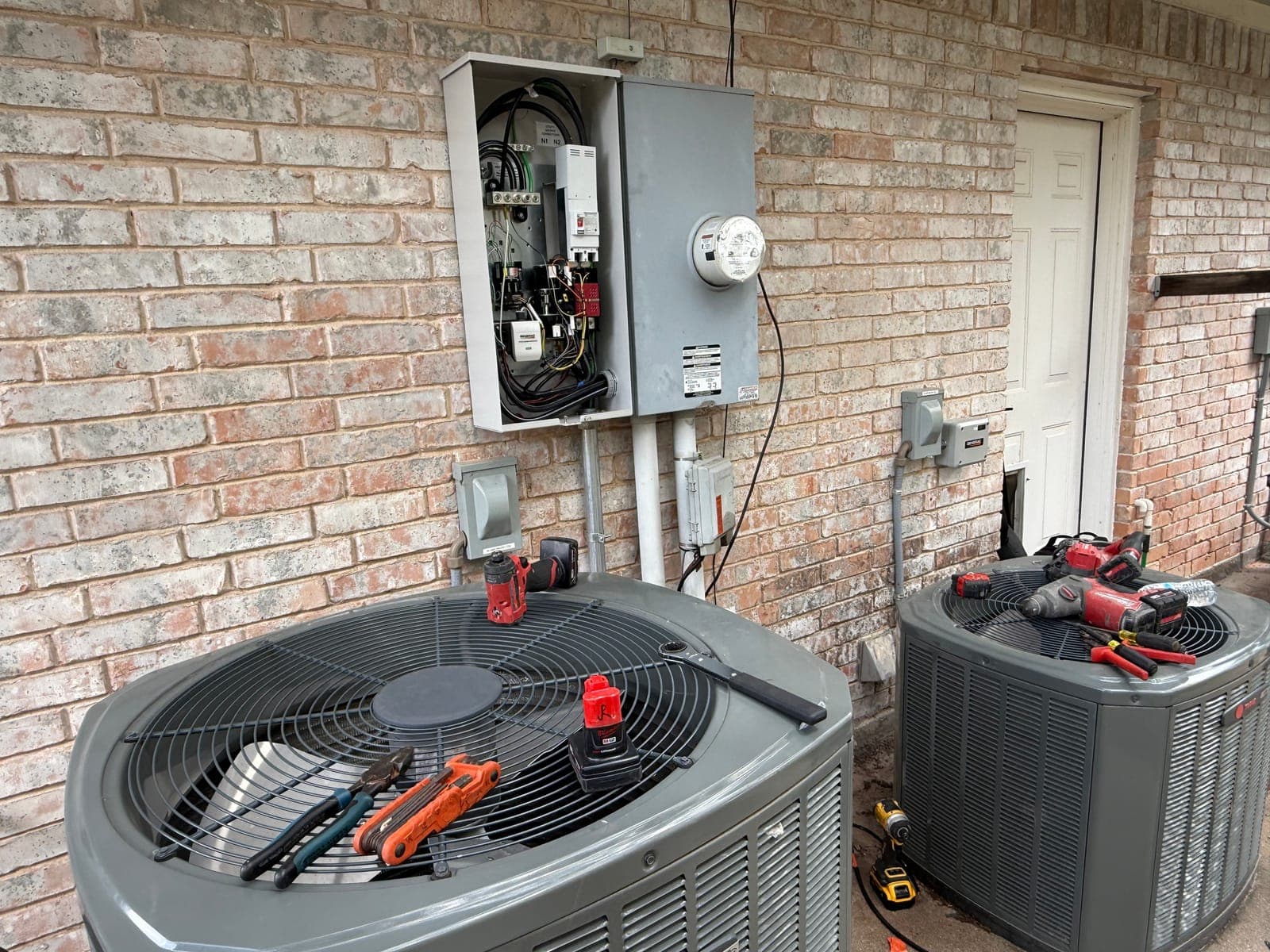
It also means almost every job is a retrofit on a finished house, so the quality of the work you can see matters. Conduit run straight and parallel to the structure, terminations dressed properly, the transfer switch mounted where it belongs rather than where it fit. The full scope is on our standby installation page.
Fuel and utility
Atmos gas, Oncor wire, and a gap between the two
Atmos Energy Mid-Tex holds the gas franchise here, with about 2,775 residential consumers on the Railroad Commission’s registry. Yet only 23.6 percent of households use that gas for heat. A house can sit on a street with a main under it and still be entirely electric inside, which is why we check the meter and the appliances rather than the map.
Where a gas connection exists, tying a generator in is usually straightforward, provided the supply can carry the machine on top of the existing appliances. A 22 kW unit at full load wants roughly 289 cubic feet an hour. Where there is no gas service, the options are establishing one or setting a propane tank, and on lots this size the tank position becomes a real constraint, since it has to sit ten feet from the generator.
On the electric side, Oncor owns and restores the wire while a retail provider of your choosing sends the bill. Report outages to Oncor, not to the name on the invoice. It is the single most common piece of confusion we clear up in this part of Tarrant County.
What we do here
Retrofit-first services
Electrical Panel Upgrades
The most common first step on pre-1980 housing stock, and often the whole job on its own.
See detailsStandby Generator Installation
Sited to the constraints of a small lot, with the transfer switch landed cleanly on an updated service.
See detailsWhole-Home Surge Protection
Older services and a lot of sensitive electronics. Layered protection at the panel and at the point of use.
See detailsLoad Management
On an all-electric house it is the difference between one machine size and the next one up.
See detailsEV Charger Installation
Level 2 charging on a properly sized circuit, planned alongside the panel and the generator.
See detailsGenerator Repair
Diagnostics and repair for Generac, Kohler, Briggs & Stratton, Cummins, Champion and Honeywell.
See details
Nearby
West Tarrant County
We work the western side of the county and out toward Parker. This is the northern end of that line.
- Benbrook, TXSouth, newer stock and larger lots, but the same all-electric picture.
- Aledo, TXWest over the county line, where the mailing address stops meaning the city.
- Willow Park, TXOut I-20, with almost no piped natural gas at all.
- Parker County, TXThe county next door, with three separate electric regimes in it.
Common questions
White Settlement generator questions
Panels, lot sizes, fuel and the airfield next door.
Will my panel take a generator connection?
That is the first thing we check, and here it is a live question more often than not. The median house in this city was built in 1973, and 60.7 percent of the housing stock predates 1980. Services of that vintage are commonly 100 amp, frequently full, and occasionally from a manufacturer with a known safety history. Where the service or panel has to be addressed we quote it as its own line and do it as part of the same project.
We heat with electricity. Does that make the generator bigger?
Usually, yes. Atmos Energy Mid-Tex serves this city with roughly 2,775 residential consumers on the Railroad Commission’s registry, but only 23.6 percent of households actually heat with piped gas while 74.1 percent heat with electricity. An all-electric house has to carry heat, hot water and cooking on the generator, which is a larger backed-up load than a gas-heated house of the same size. Load management often brings the machine back down a size, and it is cheaper than the size it saves.
The lots here are small. Where does the unit go?
With 7,485 housing units packed into five square miles, siting is the design. The generator needs five feet from any operable window, door or vent, five feet from combustible walls, five feet of overhead clearance and about three feet from shrubs, and manufacturers only allow the tighter eighteen-inch dimension against masonry on units listed for it. Add the meter position, the run back to the panel, the AC condenser and the fence line, and there are usually one or two positions that genuinely work. We find them on the site visit.
We are next to the airfield. Does that change anything?
It changes how we plan rather than what we install. Naval Air Station Fort Worth Joint Reserve Base and Air Force Plant #4 occupy territory inside the city boundaries, and the police department holds concurrent jurisdiction for calls at the base. Practically that means access, siting and scheduling get planned properly for properties along that boundary, and we confirm any site-specific requirements before the crew arrives rather than on the morning.
How often does the power actually go out?
Oncor delivers here and files its reliability numbers federally. The average Oncor customer was without power for 558.8 minutes in 2021, 231.9 in 2022, 325.5 in 2023 and 532.5 minutes in 2024. On 4 March 2025, straight-line winds of 75 to 80 mph left more than 335,000 Oncor customers without power across the service area, nearly 30,000 of them in Tarrant County. Those are wind and pole events rather than generation shortfalls, and a standby unit is a response to the first kind.
Related
Keep reading
- Electrical Panel UpgradesService capacity for houses built before anyone imagined the loads they carry now.
- Standby Generator InstallationDesign, clearances, pad, transfer switch and a live grid-failure test.
- Whole-Home Surge ProtectionProtection for electronics on an older service.
- BenbrookThe other west Tarrant city we cover, with larger lots and a separate water authority.
- Load ManagementRunning a bigger house on a smaller generator.
- Maintenance PlansAnnual and bi-annual service once the included year is up.
Two ways to start
Which one are you?
Need a generator
We start with what has to keep running at your property — the well, the AC, the freezer, the shop — and size the system around it. You get a written proposal with the equipment, the electrical work and the site prep all in one number.
Already own one
Repair, diagnostics and scheduled maintenance for Generac, Kohler and Briggs & Stratton systems — including units another company installed. Tell us the brand and what it is doing and we will bring the right parts.