
Buying guide
What Size Generator Do I Need for My House?
Generator size is set by what runs at the same time and by how hard the biggest motor hits at startup. Square footage is a proxy for that, and a poor one.
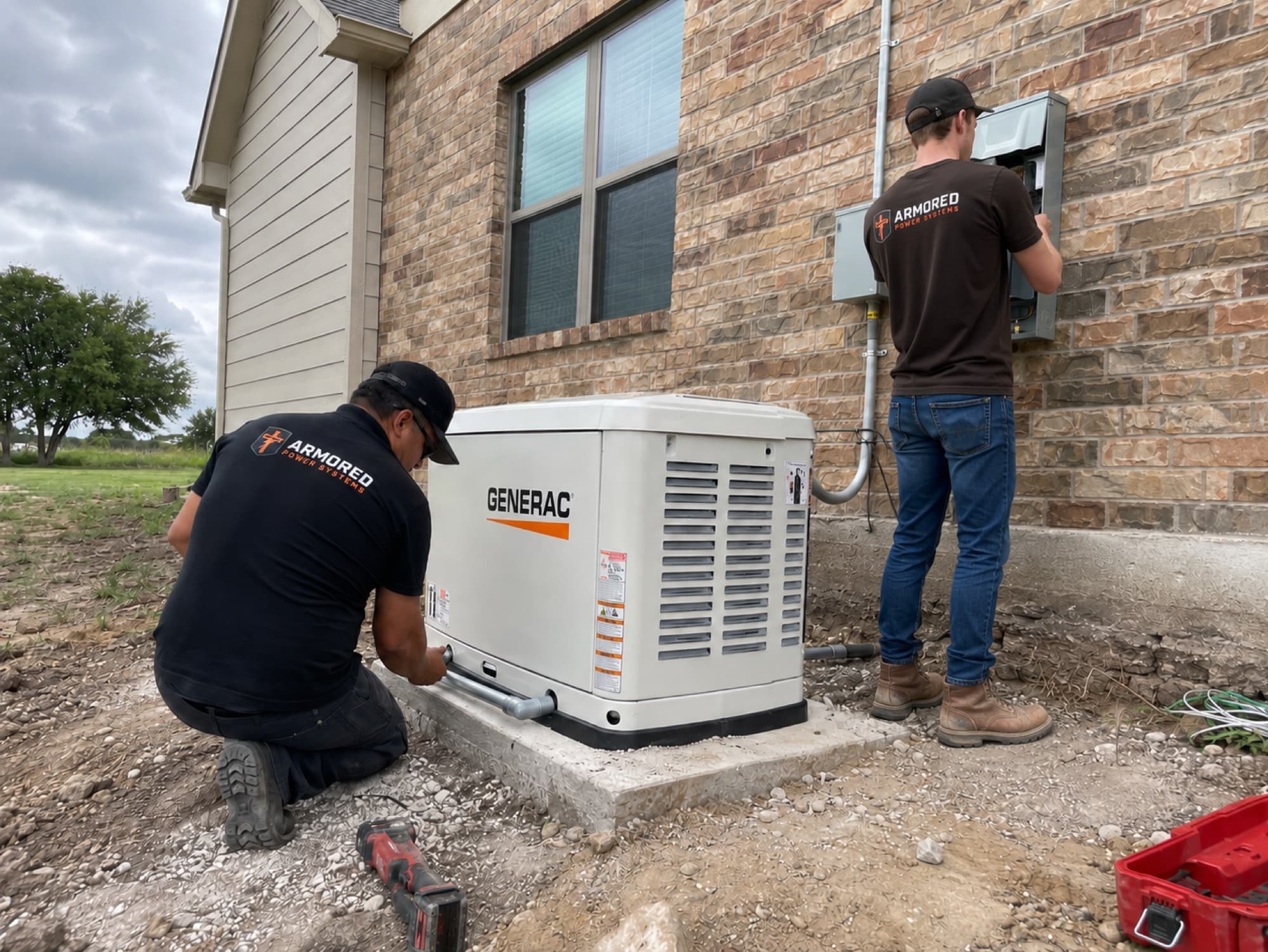
The size of a standby generator is decided by two things: the total load you want running at once, and the surge the largest motor produces at the moment it starts. Floor area correlates loosely with the first and not at all with the second, which is why the square-footage charts you find online fall apart on acreage.
Here is the practical version. Two houses, both 2,200 square feet. The first is on a city water main with a gas furnace and one three-ton air conditioner. The second is on a private well with an aerobic septic system, two compressors, a chest freezer in the garage and a shop with an air compressor. Same floor plan. Roughly double the peak demand, and a completely different answer.
Three ways to cover a house, and what each one costs you
Before anyone can size a generator, you have to decide what “backed up” means at your property. There are three normal answers, and the choice moves the generator size more than any other single decision.
Essential circuits
A smaller generator feeds a sub-panel through a load-center transfer switch, and you pick the circuits in advance: the well, the furnace blower, the refrigerator, some lighting, a few receptacles, maybe one air conditioner. It is the cheapest path and it works, provided the household accepts the list. The friction shows up on day three of an outage when somebody wants to use the oven.
Unmanaged whole home
A service-rated automatic transfer switch backs the entire panel, and the generator is sized so that everything in the house can run simultaneously. Nothing is off limits. You pay for that with a larger unit, a larger fuel supply and a larger installation.
Managed whole home
The whole panel is still backed up, but load management modules stagger the big motors so they never start together, and shed the deferrable loads when the generator approaches its limit. Every circuit stays available. The generator only has to carry a realistic worst case rather than a theoretical one. For most homes on acreage this is the version that gives the best coverage per dollar, and it is the one that gets explained least often.
Starting current is what actually sizes the machine
Running watts are easy. They add up, they are printed on nameplates, and they behave. The problem is inrush. A single-phase motor draws several times its running current for a fraction of a second while the rotor breaks loose and comes up to speed. A well pump pulling eight amps steadily can demand thirty-five amps for that instant.
A generator is rated for continuous output plus a limited surge window. Exceed the window and voltage sags, frequency drops, the controller reads an overload or under-frequency fault, and either the motor fails to start or the unit sheds the load and shuts down. This is why two properties with identical monthly kilowatt-hour usage can need generators a full size apart. The meter measures energy. The generator has to survive an instant.
The loads that dominate a rural Texas sizing calculation
The well pump
On most properties in Parker and Palo Pinto counties this is the single hardest load on the system. Submersible pumps here are typically 240-volt, half to one and a half horsepower, and they start under full head pressure with no unloading. They are also the load people forget, because a well pump makes no noise inside the house. We wrote a whole guide on what a well pump does to a generator because it comes up on nearly every site visit.
Air conditioning
In July the compressor is both the largest continuous load and the largest surge. The nameplate on the outdoor unit gives you RLA and LRA, and the LRA figure is the one that matters for sizing. Two-stage and inverter-driven systems start far more gently than a single-stage compressor. A hard-start kit or a proper soft starter can take a meaningful bite out of the surge on an older unit, and occasionally that is the difference between two generator sizes.
Septic, if it is not gravity-fed
Aerobic treatment units run a small aerator continuously, and many properties also have an effluent pump or a lift station. The watts are modest. The consequences of ignoring them are not, and it is one of the most common omissions we find on competitors’ load lists.
Refrigeration, and how much of it there is
Rural households run more refrigeration than suburban ones: the kitchen refrigerator, a garage refrigerator, one or two chest freezers, sometimes a deer freezer that only matters for two months a year and matters enormously for those two months. Individually small. Collectively significant, and they all cycle independently.
Gates, shops and the things at the end of a long run
A gate opener is a small load with an outsized nuisance value if you cannot get off the property. Shop loads (air compressor, welder, lift, dust collector) are large, intermittent and almost always the right candidate for load shedding rather than for a bigger generator.
| Load | Running watts | Starting watts |
|---|---|---|
| Submersible well pump, 1/2 HP, 240 V | ~1,000 | 2,000 – 2,500 |
| Submersible well pump, 1 HP, 240 V | ~2,000 | 4,000 – 6,000 |
| Submersible well pump, 1.5 HP, 240 V | ~2,800 | 6,000 – 8,500 |
| Central air conditioning, 3 ton | ~3,500 | 9,000 – 11,000 |
| Central air conditioning, 5 ton | ~5,000 | 12,000 – 15,000 |
| Gas furnace blower, 1/2 HP | ~800 | 2,000 – 2,400 |
| Electric heat strips, 10 kW bank | ~10,000 | ~10,000 (resistive) |
| Electric water heater, one element | ~4,500 | ~4,500 (resistive) |
| Refrigerator | ~700 | 2,000 – 2,200 |
| Chest freezer | ~500 | 1,300 – 1,600 |
| Aerobic septic aerator | 120 – 200 | 400 – 600 |
| Septic effluent or lift pump, 1/2 HP | ~1,000 | 2,000 – 2,500 |
| Driveway gate opener | ~350 | 800 – 1,200 |
| Shop air compressor, 5 HP, 240 V | ~3,700 | 9,000 – 12,000 |
| Router, modem and cell booster | 30 – 75 | No surge |
| LED lighting, whole house | 300 – 600 | No surge |
Typical planning figures only. Not a quote, and not a substitute for the nameplate on your equipment. Motor figures assume single-phase 240 V equipment with a standard across-the-line start; soft starters, inverter-driven compressors and constant-pressure well controllers reduce starting draw substantially. Resistive loads have no meaningful surge. Actual values vary by manufacturer, age, head pressure and ambient temperature.
How load management changes the answer
Add the starting watts column up and the number gets alarming fast. That total is the theoretical worst case where every motor in the house happens to start in the same half-second. Left uncontrolled, that is what an unmanaged whole-home design has to be sized for.
Load management removes the coincidence. A load manager watches the generator’s output and holds off the second compressor until the first one is running, drops the water heater while the well pump starts, and sheds the shop entirely if the house needs the capacity. Nothing is permanently disconnected; the loads simply take turns. Because the peak the generator must survive is a managed peak rather than a random one, the same coverage often fits on a smaller unit, with a smaller fuel line and a smaller bill.
What a real load calculation involves
A sizing exercise that starts with a generator model and works backwards is a sales process. A real one starts at the panel and ends at the generator. Ours looks like this, and it is worth knowing so you can tell whether the person quoting you is doing it.
- Read the panel. Every breaker, its rating, and what it actually feeds. Old directories lie. Half the circuits in a rural panel have been re-purposed at some point.
- Collect nameplate data. Condenser RLA and LRA, air handler and heat strip ratings, well pump horsepower and voltage plus the control box type, water heater element wattage, range, dryer, EV charger, shop equipment, septic aerator and pump.
- Build the must-run list with the household. Not what could theoretically run. What has to run at two in the morning in February, and what the family will actually reach for on day three.
- Check the service and the panel condition. Service size, bus condition, breaker type and whether the panel can accept what the job needs. Sometimes an electrical panel upgrade is part of the answer, and it is better to find that out now than on installation day.
- Check the fuel supply. What the gas meter can deliver at the required pressure, or what tank the property has, because fuel choice affects output and can quietly cap the size of unit the site will support.
- Choose the coverage strategy and the transfer switch, then the generator. In that order. The transfer switch and the load management plan determine what the generator has to do, so picking the machine first is backwards.
- Add headroom. A modest margin over the calculated peak, typically in the region of ten to twenty percent, so that the system is not living at its ceiling every time the weather turns.
Residential standby generators and their transfer equipment fall under NEC Article 702, Optional Standby Systems. That is the framework the design is built against, and in Texas the work is non-exempt electrical work, so it has to be performed by a licensed electrical contractor.
Summer sizing and winter sizing are different problems
Most sizing content assumes one peak. Texas has two, and they do not look alike.
A July outage is compressor-driven. Both air conditioners want to run continuously, the well pump cycles more because everyone is drinking water and filling stock tanks, and the freezers work harder in a hot garage. Peak demand is high and sustained.
A February outage is a different shape. The Texas Comptroller’s review of Winter Storm Uri recorded 139 consecutive hours at or below freezing in Dallas–Fort Worth. A gas furnace blower is a small load, so a house with gas heat gets off lightly. A house with a heat pump does not: once the outdoor temperature drops far enough, the auxiliary resistance heat strips engage, and a 10 kW strip bank is a larger continuous draw than the air conditioning ever was. If your heat is electric, tell whoever sizes your system, because it can move you a size class on its own. There is more on what that week actually looked like in our guide to Texas power outage preparedness.
What to have ready before you call anyone
You do not need to do the calculation yourself. Having these four answers ready makes the site visit far more productive, and it makes competing proposals genuinely comparable.
- Is your heat gas or electric, and if it is a heat pump, how large is the strip bank?
- Well or city water, and if it is a well, what horsepower and what kind of controller?
- Gravity septic, or an aerobic system with an aerator and a pump?
- Natural gas at the property, or propane, and if propane, what size tank and is it owned or leased?
With those four answers and a look at the panel, the size stops being a guess. If you want that done at your property, we build the load list first and quote the standby generator installation against it, so the number you get is tied to something you can check.
Written by the Armored Power Systems team. Systems designed under Master Electrician oversight, TECL #41587.
Common questions
Sizing questions we get asked most
What size generator do I need for a 2,000 square foot house?
There is no honest single answer, and any page that gives you one is guessing. A 2,000 sq ft house on city water with a gas furnace and one 3-ton compressor is a much smaller sizing problem than a 2,000 sq ft house on a well with an aerobic septic system, two compressors and a shop. The floor area is the same; the peak demand is not close. Size from the load list, not the floor plan.
Can a 22 kW generator run a whole house?
Sometimes, and it depends entirely on what the house runs and whether the system manages large loads. A 22 kW air-cooled unit covers a great many Texas homes comfortably when the transfer switch includes load management. The same unit will struggle on a property with two compressors, a 1.5 HP well pump, electric heat strips and a workshop all able to start at once with nothing coordinating them.
Does a load management module really let me buy a smaller generator?
Often, yes. Load management works by preventing two large motors from starting in the same instant and by shedding non-critical loads when the generator approaches its limit. Because the surge from simultaneous starts is usually what forces a bigger unit, controlling that surge can move a property down a size class without giving up any circuits.
Is a bigger generator always the safer choice?
No. An oversized unit costs more to buy, costs more to install because of the larger pad, gas line and transfer switch, and burns more fuel on every exercise cycle and every outage hour. On propane that shows up directly in runtime. The right answer is a unit sized to the real load list with sensible headroom, not the largest one the budget tolerates.
Do I need a bigger generator if I have an EV charger?
Usually not. Vehicle charging is the textbook deferrable load, and most designs put the charger on a managed circuit that is shed the moment the generator picks up the house. You keep the ability to charge if the outage runs long and the rest of the load is light, without paying for a generator sized around a car.
Related
Keep reading
- Generator SizingA load calculation that decides how much generator your property actually needs — before anyone quotes a price.
- What Does a Whole-Home Generator Power?The badge on the enclosure does not decide what stays on. The transfer switch and the load plan do. Here is what that looks like system by system.
- Do I Need a Generator for My Well Pump?On a well, an outage is a water outage. Starting current, pressure tank drawdown, and what happens to an aerobic septic system when the power stops.
- Load ManagementSmart load control that lets a smaller, cheaper generator cover a bigger house.
Two ways to start
Which one are you?
Need a generator
We start with what has to keep running at your property — the well, the AC, the freezer, the shop — and size the system around it. You get a written proposal with the equipment, the electrical work and the site prep all in one number.
Already own one
Repair, diagnostics and scheduled maintenance for Generac, Kohler and Briggs & Stratton systems — including units another company installed. Tell us the brand and what it is doing and we will bring the right parts.