
Cost guide
What Does a Whole-Home Generator Cost in Texas?
No one can price a whole-home generator over the internet, and the averages you have been reading were built from jobs that look nothing like yours. Here is what genuinely moves the number.
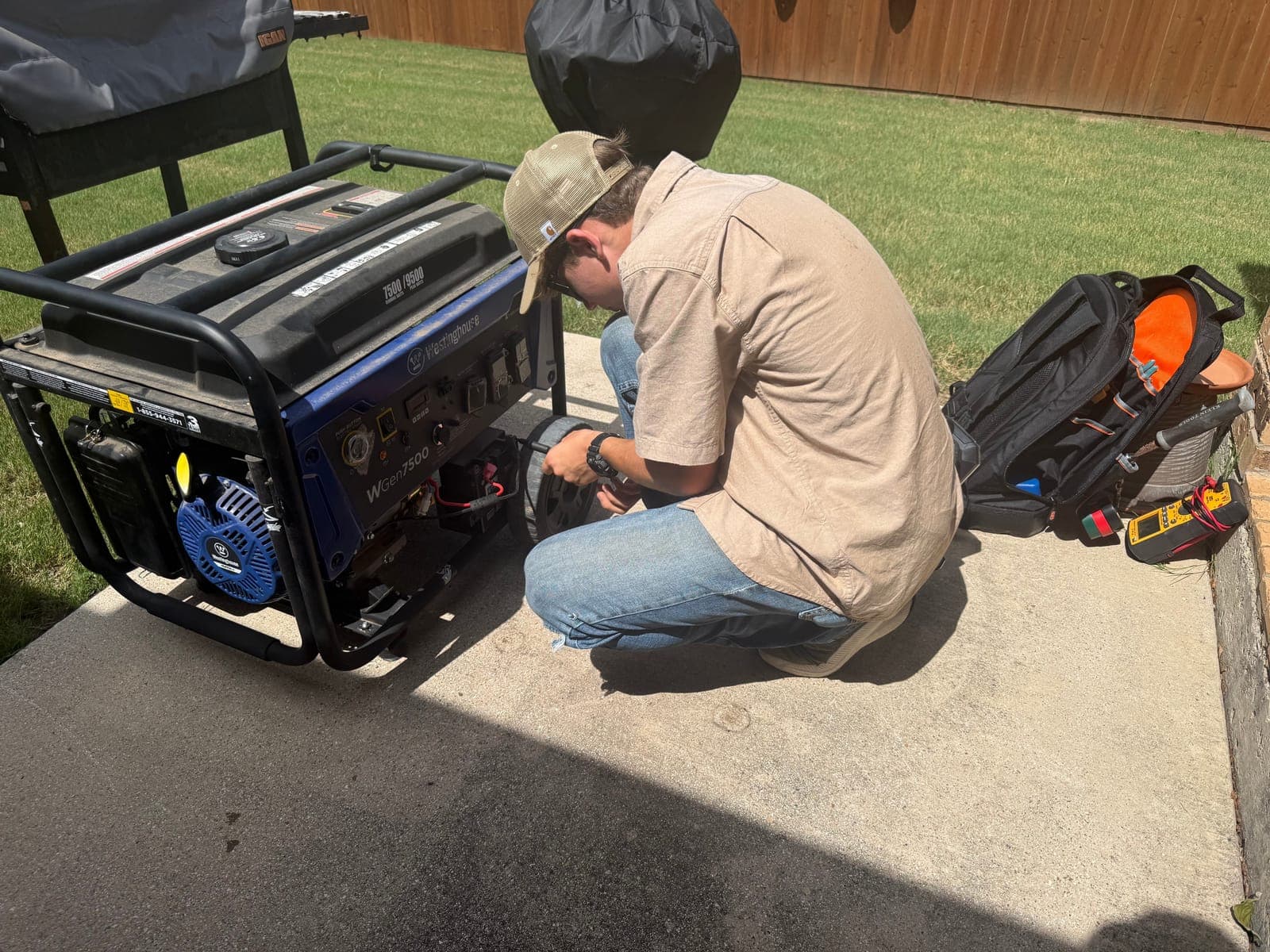
The cost of a whole-home standby generator in Texas is driven by the size of the unit, the fuel supply, the transfer switch, the distance between the meter and the pad, and the condition of the electrical service it connects to. On rural acreage the site work alone can vary by thousands of dollars between two houses on the same road.
You will find plenty of pages that answer this question with a number. We are not going to, and it is worth explaining why before we get into the parts you can use.
Why there is no price on this page
A whole-home generator is not a product with a price. It is a product plus a set of site conditions, and the site conditions are the part that varies. Publishing a range narrow enough to be useful would mean publishing a number that is wrong for most of the properties we work on, which does you no favours: you either anchor on a figure you cannot get, or you rule out a system that would actually have fit your budget.
What we can do is show you every line item that moves the total, so that when you do get proposals you can read them properly. That is more useful than a number, and it is the reason this page exists.
Why the national averages mislead on a rural Texas property
The cost figures that dominate search results come from national home-services marketplaces that average whatever their contractors report. Three problems follow from that.
First, the data blends different products. A permanently installed standby generator, a portable generator with an interlock kit, and a transfer-switch-only job all get filed under “generator installation.” Averaging them produces a number far below what a genuine whole-home standby system costs, which is why some of those published averages look implausibly low to anyone who has actually bought one.
Second, the geography is wrong for you. Those averages are weighted toward suburban tract housing: short runs, a gas main at the street, a level lot, a recent panel, a pad six feet from the meter. If your generator has to sit ninety feet from the house because that is where the propane tank and the clearances allow, none of that applies.
Third, they exclude the rural variables entirely. Well pumps, aerobic septic systems, shops, barns, long conductor runs across a pasture, caliche and rock, and gas supply that has to be upsized are not in the model at all. Those are the things that decide the number here.
The ten things that actually move the number
1. Generator size
The largest single line on the proposal, and the one most people focus on. It is set by the load calculation, not by the house size, which is covered properly in what size generator you need. Worth knowing: stepping up one size within the air-cooled range is a smaller jump than most people expect. Crossing from air-cooled to liquid-cooled is not.
2. Air-cooled or liquid-cooled
Air-cooled units cover the majority of homes and are the cheaper machine to buy and to install. Above a certain size the range moves to liquid-cooled: a bigger engine, a coolant system, a larger enclosure, a heavier pad, larger conductors and a larger fuel demand. It is a genuine step change in cost, not a gradual slope, and it is why the load calculation matters financially, not just technically.
3. Fuel type and what the supply can deliver
On natural gas, the question is whether the existing meter and piping can supply the generator at the pressure it needs while the house’s other appliances are running. A standby generator is a large gas appliance. Long runs need larger pipe, and sometimes the utility has to be involved in the meter set. On propane, the question is tank size, whether it is owned or leased, where it can legally sit relative to the generator, and the piping between them. Propane versus natural gas goes through both in detail.
4. Distance from the meter and panel to the pad
Every foot between the generator and the electrical service is conductor, conduit and trench. Every foot between the generator and the gas source is pipe. Clearance rules, the septic field, the driveway and the neighbors’ sight lines all push the pad away from the house, and the budget follows it. This is routinely the biggest difference between two otherwise identical jobs.
5. The pad and the excavation
A composite pad on level, diggable ground is straightforward. Caliche, rock, a slope that has to be benched, or a location that needs poured concrete and cure time is not. Nobody knows which one you have until someone stands on the spot.
6. Transfer switch type
A load-center switch feeding a set of essential circuits and a service-entrance-rated whole-home switch are different devices at different prices, and they require different amounts of work at the service. If two proposals differ and you cannot see why, this is the first line to compare. Our page on automatic transfer switches explains what each type does.
7. Panel and service condition
Older rural panels sometimes cannot accept the work cleanly: no room, an obsolete bus, a service that is undersized for what the household now runs, or a meter can that has to be replaced to land a service-rated switch. An electrical panel upgrade is not always needed, but when it is, it belongs in the proposal rather than in a surprise conversation on installation day.
8. Load management
The one line that can reduce the total. Load management modules cost money and frequently save more than they cost, because they let a smaller generator carry the same coverage. Any proposal that has not considered them is quoting a bigger machine than you may need.
9. Permitting and inspection
Requirements are not uniform across the service area, and Texas changed the rules for residential backup power systems in 2025. What applies at your address depends on the jurisdiction, and it is something we confirm during design rather than assume. Licensing did not change: this is non-exempt electrical work and has to be done by a licensed Texas electrical contractor.
10. Access and terrain
A generator is heavy and it has to get to the pad. A gate that will not pass a trailer, a soft approach after rain, a cattle guard, a long driveway or a pad location a truck cannot reach all add labor and equipment. This is an acreage cost that suburban averages never capture.
| Line item | Pushes the cost up | Holds the cost down |
|---|---|---|
| Generator size | Electric heat, two compressors, a shop, a large well pump | Gas heat, one compressor, a disciplined must-run list |
| Cooling type | Crossing into the liquid-cooled range | Staying within the air-cooled range |
| Fuel supply | Meter or regulator upgrade, long gas run, new propane tank and set | Adequate existing meter, or a correctly sized tank already on site |
| Distance to the pad | Long conductor and gas runs, trenching across a drive | A compliant pad location close to the meter and panel |
| Ground conditions | Rock, caliche, slope, poured concrete | Level, diggable ground and a composite pad |
| Transfer switch | Service-entrance-rated whole-home switch | Load-center switch on selected essential circuits |
| Panel and service | Undersized service, obsolete panel, meter can replacement | A healthy panel with capacity and space |
| Load management | Adds modules to the bill of materials | Often permits a smaller generator, a smaller net cost |
| Site access | Narrow gates, soft ground, long or steep driveway | Truck and trailer access to within reach of the pad |
Planning reference only, and deliberately free of dollar figures — this is direction of travel, not a quote or a price range. Every property differs, and the only figure that means anything is the one on a written proposal for your address.
What a complete installed price should include
Use this as a checklist against any proposal you receive, ours included. If a line is missing, ask whether it is excluded or simply unlisted, because the two have very different consequences.
- The generator, with the model and kW rating stated, and the fuel it is configured for
- The transfer switch, with its type and rating stated, not just the word “ATS”
- Load management modules, if the design uses them
- The pad, and whether it is composite or poured
- Trenching, conduit, conductors and the length of the run
- Gas piping, regulator, and any meter or tank work, including who coordinates with the utility or the propane supplier
- Any panel, service or grounding work the connection requires
- Permitting, inspection and the plan review path
- Commissioning: startup, exercise schedule, monitoring setup and a walkthrough of the controller
- What happens in the first year on maintenance
That last line is worth pressing on. Every new generator we install includes the first full year of routine maintenance, and after that the ongoing service sits on a maintenance plan with published pricing. Whatever company you use, know before you sign whether year one is covered and what year two costs.
The costs that come after the installation
The purchase is not the whole picture, and a proposal that ignores the running costs is only telling you half the story.
- Fuel. The weekly or bi-weekly exercise cycle burns fuel, and an outage burns considerably more. On propane it is a metered cost you will notice; on natural gas it lands on the utility bill.
- Scheduled maintenance. Oil, filters, plugs and a battery on interval. Skipping it is the most expensive saving available, because the failures it prevents happen during outages when parts and technicians are hardest to get.
- Battery replacement. A consumable, not a repair. Texas heat is harder on a standby battery than Texas cold, and it is the leading cause of a unit that does not start.
- Repairs outside the warranty period. Which brings the question of who services the brand locally, and how quickly parts arrive, back into the buying decision. Our comparison of Generac and Kohler covers that.
How to compare two proposals without a price list
You do not need to know the market rate to tell a good proposal from a thin one. Four questions separate them.
- Did anyone do a load calculation? Ask to see it. If the answer is the square footage of your house, the size is a guess and every number downstream of it is too.
- Is the transfer switch specified by type? Whole-home service-rated switches and essential-circuit switches are not interchangeable and not comparable in price.
- Is the fuel work in scope? Gas line sizing, regulator, meter coordination, tank set. This is a classic omission, and it is not small.
- Who services it afterwards, and out of where? A cheaper installation from a company two hours away is not cheaper on the day the unit faults during an ice storm.
Where that leaves the number
The honest position is the one we started with. A whole-home generator can be quoted properly only after someone has stood on the ground, opened the panel, measured the run and looked at the fuel supply. Everything before that is a range built from other people’s houses.
When we quote a job, the equipment, the electrical work, the site prep and the permitting arrive as one written number tied to a load list you can read. Financing is available through multiple lenders, subject to credit approval, and we would rather show you the financing options alongside the proposal than after it. If you want the real figure for your property, request an estimate and we will come and work it out.
Written by the Armored Power Systems team. Systems designed under Master Electrician oversight, TECL #41587.
Common questions
Cost questions we get asked most
Why will you not publish a price range?
Because a range wide enough to be honest is too wide to be useful, and a range narrow enough to be useful would be wrong for most of the properties we work on. Two houses a mile apart on the same road can differ by thousands of dollars in site work alone, before anyone chooses a generator. We would rather explain what moves the number and then put a real one in writing after a site visit.
Does a generator cost more on propane than on natural gas?
Usually yes, once the tank is accounted for. The generator itself is the same machine. Propane adds a tank you either buy or lease, a set, a regulator and the piping to it, and the tank has to be sized for real runtime rather than for the minimum that will start the engine. Against that, propane removes any dependence on a gas main, which is why most of the rural properties we work on run it.
Why is one quote so much lower than another?
Almost always scope. Check whether each proposal includes the transfer switch and what type it is, the pad, the trenching and conductor run, the gas line and any meter or regulator work, permitting and inspection, load management modules, commissioning and the first exercise setup. A lower number frequently means one or more of those is missing and will come back as a change order.
Does the generator size drive most of the cost?
It is the biggest single line, but it is rarely the reason two quotes for the same house differ. Site conditions do that. Distance from the meter to the pad, the state of the panel, the fuel supply and the ground you have to dig through move the total far more than a step from one air-cooled size to the next.
Is financing available?
Financing is available through multiple lenders, subject to credit approval. We can point you at the applications during the proposal stage so the payment structure is part of the decision rather than an afterthought.
Related
Keep reading
- Standby Generator InstallationA permanently installed system that starts on its own when the utility drops and runs the house until power returns.
- What Size Generator Do I Need for My House?Square footage is a proxy, not a method. Here is what actually sets the size: motor starting loads, how many of them can run at once, and whether the system manages them.
- FinancingFinancing available through multiple lenders, subject to credit approval.
- Generator Maintenance PlansScheduled service tiers, and the first year of routine maintenance free on a new installation.
Two ways to start
Which one are you?
Need a generator
We start with what has to keep running at your property — the well, the AC, the freezer, the shop — and size the system around it. You get a written proposal with the equipment, the electrical work and the site prep all in one number.
Already own one
Repair, diagnostics and scheduled maintenance for Generac, Kohler and Briggs & Stratton systems — including units another company installed. Tell us the brand and what it is doing and we will bring the right parts.