
Ask three companies to size a generator for the same house and you can get three different answers. That is not because sizing is mysterious. It is because two of them are adding up running watts, and running watts are not what decides the machine.
The number that matters is the surge
An induction motor — the compressor in your air conditioner, the submersible pump in your well — draws several times its running current in the instant it starts. A pump that runs at 10 amps can pull 50 or more for a fraction of a second while it gets moving. That fraction of a second is the whole sizing problem.
A generator that can comfortably run every load in your house can still stall, or drop voltage far enough to trip things offline, when two of those motors try to start at the same moment. Sizing on running watts produces a number that looks adequate on paper and behaves badly on a July afternoon.
Which is why the count of motors matters more than the square footage
Square footage is a proxy for load, and a poor one. A 4,000-square-foot house on municipal water with one air conditioner is an easier problem than a 1,800-square-foot house on a well with two compressors and a septic lift pump. The second one has more motors, and motors are what start.
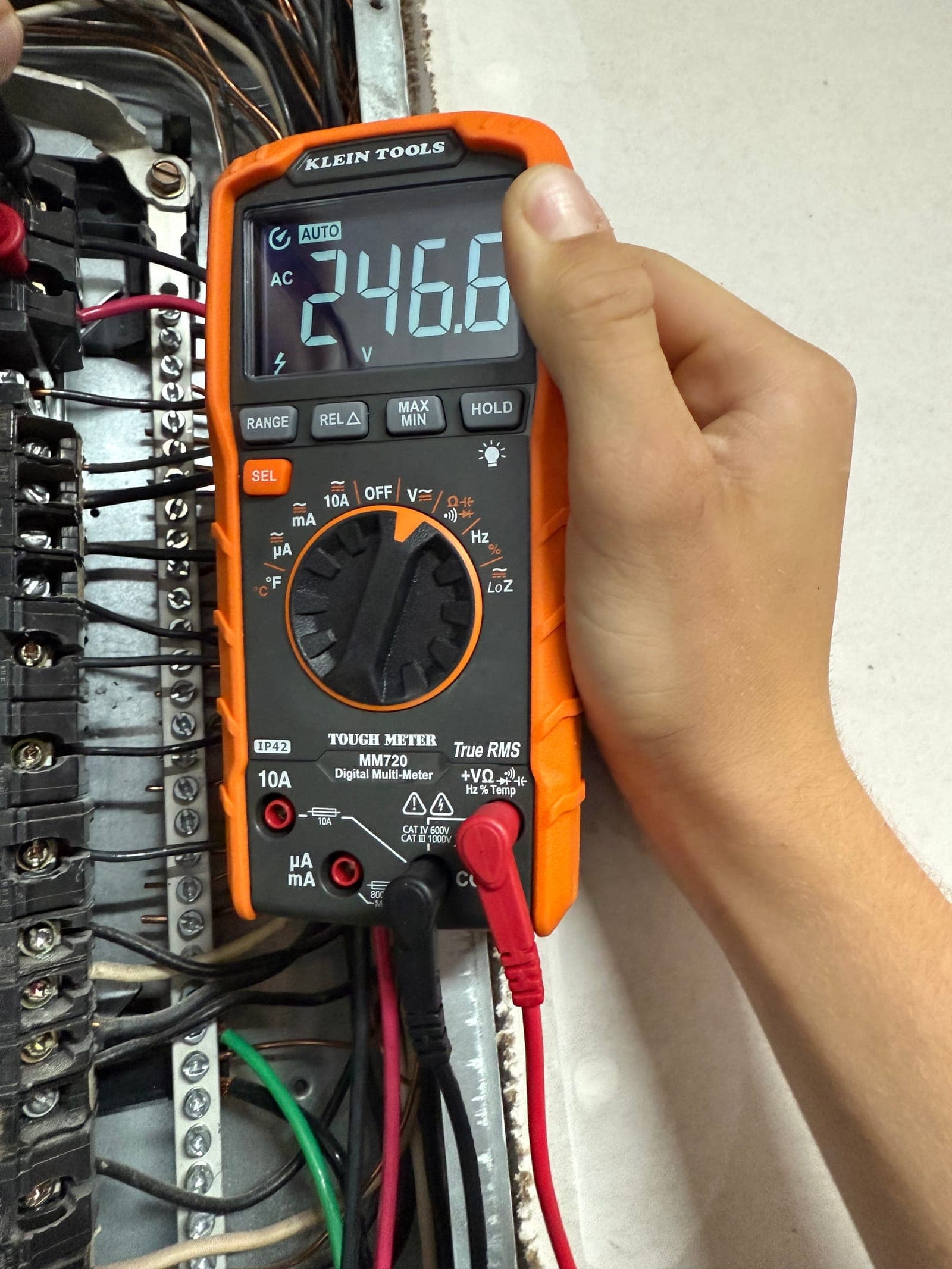
That is why we walk the property and measure rather than quoting from a floor plan. Running amperage and startup amperage on each significant load, taken from the equipment that is actually installed.
Two ways to make the number smaller
Once the starting loads are known, there are two honest ways to avoid buying a larger machine.
The first is load management: deciding in advance which loads may start and in what order, so the simultaneous-start case never arises. Removing that case is usually what shrinks the generator, and it is normally cheaper than the next size up.
The second is a soft-start device on the air conditioner, which reduces the compressor's inrush directly rather than managing around it. On a house where one compressor dominates the calculation, that single component can change which model is correct.
What to ask for
If you are comparing proposals, the useful question is not "how many kilowatts". It is "what did you measure, and what did you assume starts at the same time". A proposal that can answer that is describing a system. One that cannot is describing a price.
More on the arithmetic in what size generator do I need, or we can come and measure — request an estimate.